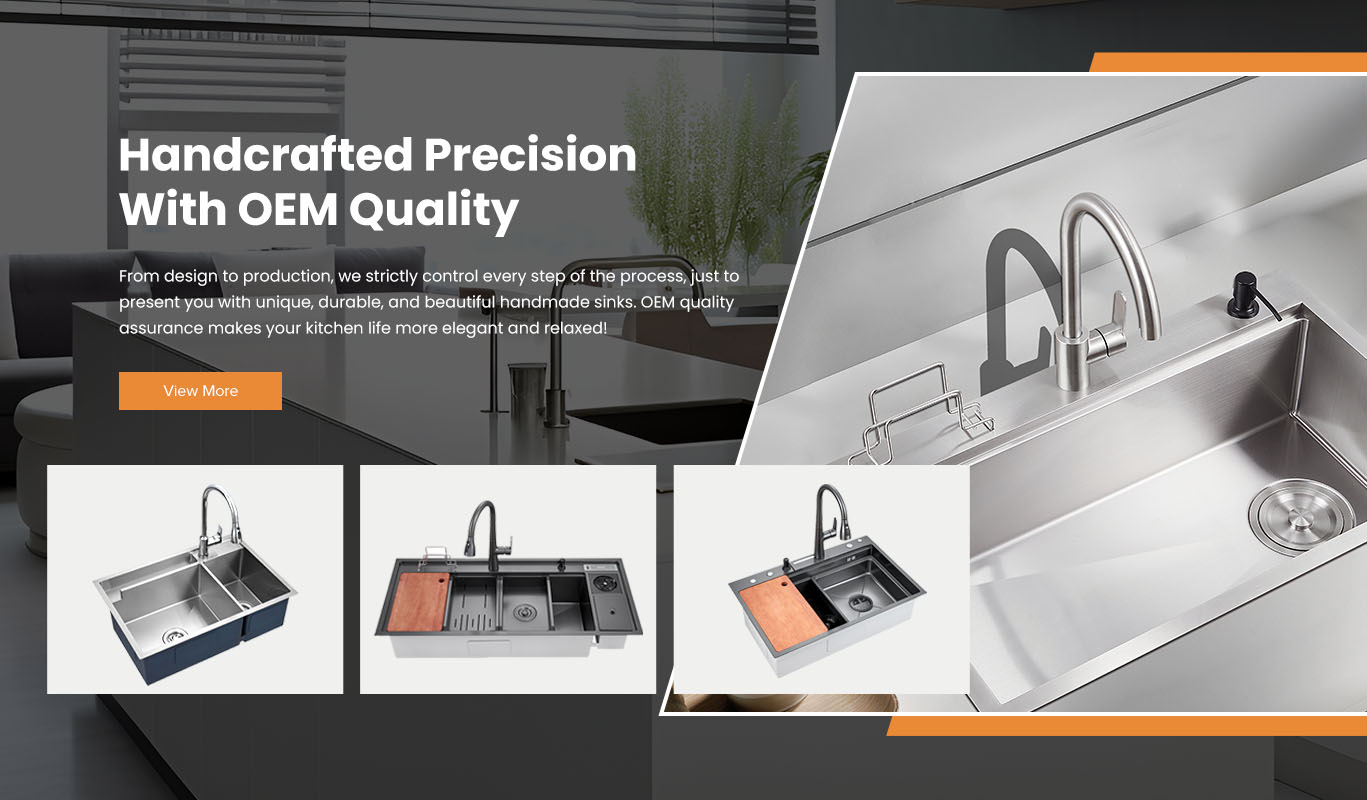
A nano coated sink provides improved surface protection, easier cleaning, and enhanced water resistance, while a traditional stainless steel sink offers proven durability and reliable performance. The better choice depends on usage conditions and maintenance expectations.
The main difference between a nano coated sink and a traditional stainless steel sink is the surface treatment applied after the stainless steel manufacturing process.
A nano coated sink has an additional protective coating layer applied to the stainless steel surface. This coating helps reduce water marks, oil adhesion, stains, and daily residue.
A traditional stainless steel sink uses the natural properties of stainless steel, relying on material quality, surface finishing, and manufacturing precision to provide durability.
From a manufacturer’s perspective, surface treatment is an important factor affecting user experience. The right choice depends on cleaning habits, application environment, design requirements, and expected maintenance level.
A nano coated sink is designed to improve the everyday cleaning experience.
Key advantages include:
Reduced water stain visibility
Better resistance to oil and residue
Easier surface cleaning
Improved surface smoothness
The nano coating creates a protective layer that helps prevent common kitchen problems such as:
Water spots
Food residue adhesion
Fingerprints
Daily cleaning marks
This makes nano coated sinks suitable for:
Modern residential kitchens
Premium kitchen projects
High-use environments
Customers seeking easier maintenance
A traditional stainless steel sink remains a popular choice because of its proven reliability.
Its main advantages include:
Strong corrosion resistance
Long service life
Simple maintenance requirements
Established manufacturing technology
Traditional stainless steel sinks are commonly used for:
Residential kitchens
Commercial kitchens
Large-scale projects
Standard product applications
High-quality stainless steel combined with proper surface finishing can provide excellent durability without additional coatings.
Cleaning convenience is one of the main differences between these two options.
A nano coated sink provides advantages because:
Water and oil are less likely to remain on the surface
Residue can be removed more easily
Daily cleaning requires less effort
A traditional stainless steel sink can also be easy to clean, especially when using:
Proper surface finishes
Regular maintenance
Suitable cleaning methods
However, nano coating technology is designed specifically to improve surface maintenance.
Nano coating can improve surface protection, but actual performance depends on coating quality and usage conditions.
Potential advantages include:
Reduced stain attachment
Better resistance to daily marks
Easier removal of residue
Traditional stainless steel sinks rely mainly on:
Material strength
Surface treatment
Proper maintenance
For both types, avoiding harsh cleaning tools and abrasive chemicals helps maintain surface quality.
Surface treatment influences both appearance and user experience.
| Sink Surface | Appearance Characteristics | Maintenance Performance |
|---|---|---|
| Nano Coated Sink | Smooth, modern, enhanced surface effect | Easier daily cleaning |
| Traditional Stainless Steel Sink | Classic stainless steel appearance | Reliable and practical |
Nano coated sinks are often selected for modern kitchens where appearance and maintenance convenience are important.
Traditional stainless steel sinks remain popular because of their timeless design and proven performance.
High-use kitchens require surfaces that can handle frequent washing and cleaning.
Nano coated sinks provide benefits through:
Easier removal of daily residue
Better resistance to visible water marks
Improved cleaning efficiency
Traditional stainless steel sinks provide benefits through:
Strong durability
Proven long-term performance
Easy repair and maintenance
The better option depends on whether the priority is easier maintenance or maximum material simplicity.
Nano coating quality depends on proper production control.
Important factors include:
| Quality Factor | Performance Impact |
|---|---|
| Stainless steel quality | Provides structural durability |
| Coating uniformity | Affects surface protection |
| Adhesion performance | Determines coating stability |
| Surface preparation | Improves coating effectiveness |
| Final inspection | Ensures product consistency |
Professional manufacturers carefully control coating processes to maintain reliable surface performance.
OEM requirements vary depending on target markets and product positioning.
Nano coated sinks are suitable for OEM projects requiring:
Premium product features
Modern kitchen solutions
Easier maintenance benefits
Differentiated product positioning
Traditional stainless steel sinks are suitable for OEM projects requiring:
Reliable standard products
Broad market applications
Efficient production
Long-established performance
Manufacturers can provide different surface solutions based on customer requirements.
Not necessarily.
A nano coated sink provides additional surface benefits, but traditional stainless steel sinks remain valuable because of their durability and proven performance.
A nano coated sink is more suitable when:
Easy cleaning is important
Premium features are desired
Modern appearance is preferred
A traditional stainless steel sink is more suitable when:
Simple and reliable performance is required
Cost efficiency matters
Standard applications are the priority
The right choice depends on actual usage requirements.
The selection should consider cleaning habits, application environment, and product expectations.
A nano coated sink is recommended when:
Maintenance convenience is important
Premium kitchen features are needed
Surface protection is a priority
Modern product positioning is desired
A traditional stainless steel sink is recommended when:
Durability is the main requirement
Standard performance is sufficient
Cost balance is important
Proven materials are preferred
Choosing the correct surface technology helps achieve the right balance between performance, appearance, and long-term value.
A nano coated sink provides better surface performance through improved stain resistance, easier cleaning, and enhanced maintenance convenience. A traditional stainless steel sink provides reliable durability, corrosion resistance, and proven long-term performance.
The ideal choice depends on application needs, cleaning expectations, product positioning, and customer preferences.