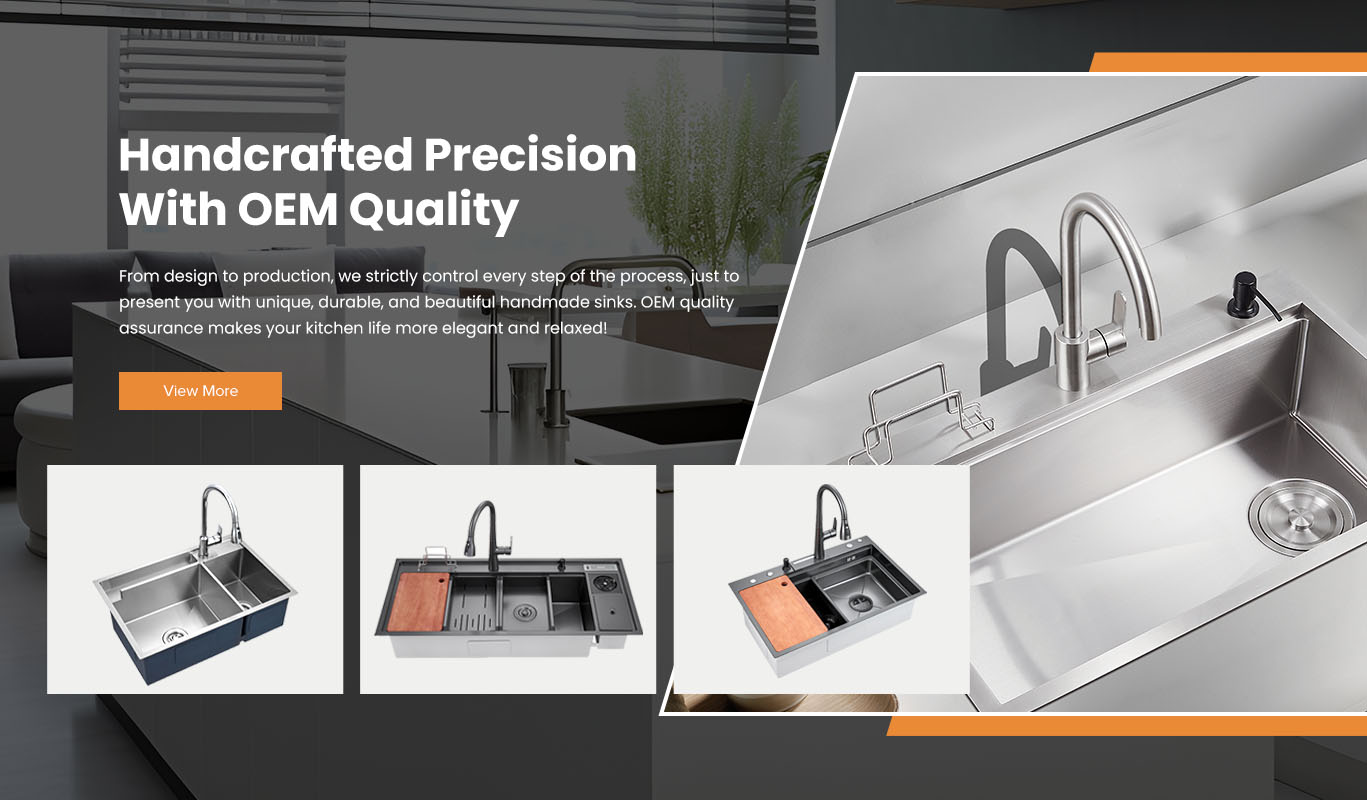
A handmade stainless steel sink offers higher customization and craftsmanship, while a pressed sink provides consistent production efficiency. The better process depends on quality expectations, application needs, and production requirements.
The main difference between a handmade stainless steel sink and a pressed sink is the manufacturing process used to shape and assemble the product.
A handmade stainless steel sink is produced through multiple processes, including cutting, bending, welding, grinding, polishing, and inspection. This method allows manufacturers to control individual details and create customized designs.
A pressed sink is manufactured by forming stainless steel sheets through molds and mechanical pressing equipment. This process focuses on production efficiency, dimensional consistency, and large-volume manufacturing.
From a manufacturer’s perspective, the better process depends on the intended application. Premium projects may require customization and detailed craftsmanship, while large-scale supply programs may prioritize stable production efficiency.
Handmade sink production provides greater flexibility because each manufacturing stage can be adjusted according to product requirements.
Key advantages include:
Flexible customization of sink dimensions
More options for bowl configurations
Precise control of edge and corner details
Better suitability for unique kitchen designs
During production, skilled technicians can adjust welding positions, surface finishing, and structural details based on specific requirements.
This makes handmade stainless steel sinks suitable for:
Luxury residential kitchens
Customized kitchen projects
Premium interior applications
Brands seeking differentiated products
For manufacturers, handmade production requires experienced craftsmanship, strict process control, and detailed quality inspection to maintain consistent standards.
Pressed sinks focus on manufacturing consistency through standardized forming technology.
Their main advantages include:
Stable product dimensions
Efficient mass production capability
Consistent appearance across large quantities
Reduced production variation
The pressing process allows manufacturers to produce large volumes of sinks with similar structures and specifications.
Pressed sinks are commonly used for:
Residential housing projects
Standard kitchen applications
Large-volume orders
Markets requiring reliable supply efficiency
Durability depends on multiple factors, including material quality, production accuracy, structural design, and quality control.
Handmade stainless steel sinks often provide advantages through:
Reinforced welded structures
Flexible material thickness options
Detailed finishing processes
Customized structural improvements
Pressed sinks achieve durability through:
Uniform material forming
Stable production processes
Consistent structural dimensions
Controlled manufacturing conditions
A professional manufacturer evaluates stainless steel grade, material thickness, welding quality, and product design to ensure long-term performance for both production methods.
Premium kitchens often require products that combine appearance, functionality, and uniqueness.
Handmade stainless steel sinks provide advantages such as:
Premium visual appearance
Custom design possibilities
Refined surface finishing
Better integration with high-end kitchen styles
They are often selected for projects where the sink is not only a functional product but also an important design element.
The ability to customize dimensions, corner structures, and finishes allows manufacturers to support different architectural styles and market preferences.
Pressed sinks provide strong advantages when production efficiency and consistency are priorities.
They are suitable when:
Large quantities are required
Standard specifications are preferred
Fast production cycles are important
Cost efficiency is a major consideration
For distributors, contractors, and large-scale projects, pressed sinks can provide stable supply and predictable product performance.
The standardized manufacturing process helps maintain consistent quality across high-volume production.
Manufacturing methods directly influence the final appearance of stainless steel sinks.
| Manufacturing Process | Appearance Characteristics | Suitable Applications |
|---|---|---|
| Handmade Production | Customized details and refined finishing | Premium and customized projects |
| Pressed Production | Consistent shape and standardized appearance | Large-volume applications |
Handmade processes allow more control over design details, while pressed processes provide strong consistency.
The preferred appearance depends on market positioning and customer expectations.
Quality control is essential regardless of manufacturing method.
Important inspection factors include:
| Quality Control Factor | Performance Impact |
|---|---|
| Stainless steel inspection | Ensures material reliability |
| Dimension checking | Maintains installation accuracy |
| Welding inspection | Improves structural strength |
| Surface inspection | Ensures appearance consistency |
| Water testing | Confirms drainage performance |
Professional sink manufacturers combine production technology with quality management systems to deliver reliable products for different markets.
OEM requirements vary according to product strategy and target markets.
Handmade stainless steel sinks are suitable for OEM projects requiring:
Unique product designs
Premium market positioning
Customized specifications
Brand differentiation
Pressed sinks are suitable for OEM projects requiring:
Standardized products
Large production volumes
Efficient manufacturing
Stable supply capacity
A capable manufacturer can provide different production methods based on customer positioning and application requirements.
The correct choice depends on product goals, market positioning, and quality expectations.
A handmade stainless steel sink is recommended when:
Customization is important
Premium appearance is required
Product differentiation is needed
High-end applications are targeted
A pressed sink is recommended when:
Large quantities are required
Production efficiency matters
Standard designs are preferred
Cost control is important
The best manufacturing process is the one that matches the intended application and market strategy.
A handmade stainless steel sink generally provides better customization flexibility and premium craftsmanship, while a pressed sink offers consistent quality and efficient mass production.
The better manufacturing process depends on product positioning, application requirements, customization needs, and expected market value.