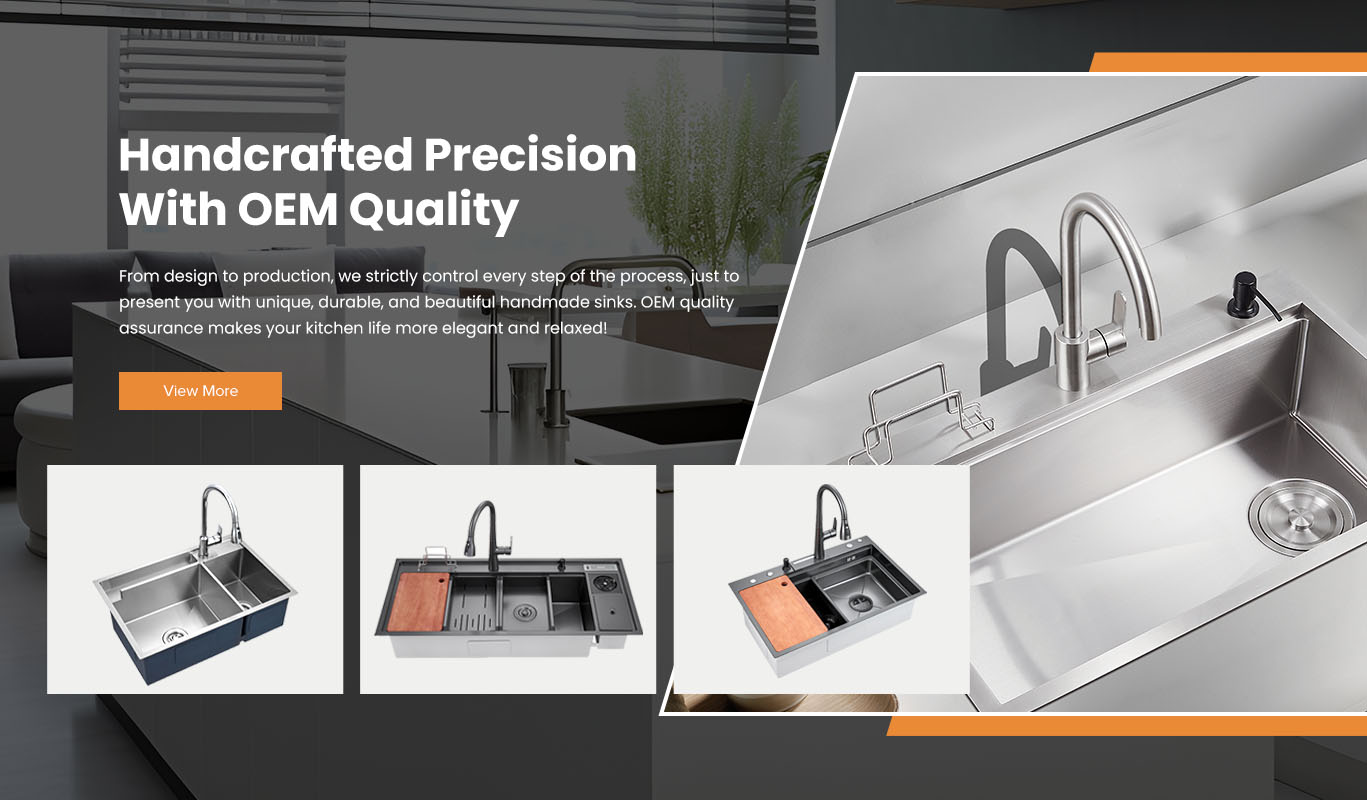
An undermount sink delivers higher value for premium kitchen designs through seamless integration, while a surface mounted sink offers wider compatibility and installation efficiency. The better choice depends on target market and project requirements.
The main difference between an undermount sink and a surface mounted sink is the installation position and how the sink interacts with the countertop.
An undermount sink is installed beneath the countertop surface, creating a smooth transition between the sink and surrounding workspace. This design focuses on premium appearance, easier countertop cleaning, and integrated kitchen aesthetics.
A surface mounted sink is installed on top of the countertop, with the sink edge visible above the working surface. This structure provides simpler installation, broad compatibility, and practical application flexibility.
From a manufacturing perspective, market value is influenced by more than installation style. Product design, manufacturing quality, application positioning, customer expectations, and long-term usability all determine commercial value.
An undermount sink is often associated with high-end kitchen solutions because of its seamless appearance and modern design characteristics.
Key value advantages include:
Creates a cleaner countertop appearance
Supports minimalist and premium kitchen styles
Improves countertop cleaning convenience
Enhances overall kitchen design consistency
The hidden installation method allows the sink to become part of the kitchen architecture rather than appearing as a separate component.
This makes undermount sinks suitable for:
Luxury residential kitchens
Premium apartment developments
Designer kitchen projects
High-end renovation markets
For manufacturers, producing undermount sinks requires higher precision in dimensions, edge finishing, welding quality, and mounting structures to meet premium market expectations.
A surface mounted sink delivers strong market value through practicality and installation flexibility.
Its main advantages include:
Compatible with various countertop materials
Easier installation process
Convenient replacement options
Suitable for wider market applications
Because the sink is installed above the countertop, it can adapt to different project conditions with fewer installation limitations.
Surface mounted sinks are commonly used in:
Residential housing projects
Commercial kitchen applications
Renovation markets
Cost-conscious projects
For many markets, installation efficiency and product reliability are key factors that create strong commercial value.
Customer perceived value depends on the target market.
Undermount sinks often create higher perceived value because customers associate them with:
Modern design
Premium materials
Customized kitchen solutions
Better visual integration
Surface mounted sinks create value through:
Practical functionality
Easy maintenance access
Installation convenience
Cost efficiency
Different customer groups evaluate value differently. Premium markets may prioritize appearance, while large-scale projects may focus more on reliability and installation efficiency.
For brands seeking product differentiation, undermount sinks often provide stronger opportunities.
Reasons include:
More premium visual positioning
Greater customization potential
Better compatibility with modern kitchen trends
Stronger design appeal
Manufacturers working with kitchen brands and customized projects often develop undermount solutions to create unique product lines.
However, surface mounted sinks remain valuable for markets that require standardized products and efficient supply solutions.
Market potential depends on industry trends and customer demand.
Undermount sinks benefit from growing demand for:
Modern kitchen design
Premium home improvement products
Customized interior solutions
Seamless countertop systems
Surface mounted sinks continue to maintain strong demand because of:
Broad installation compatibility
Reliable performance
Competitive pricing
Simple project application
A complete product strategy often includes both designs to address different market segments.
Installation method alone does not determine product value. Manufacturing quality plays a critical role.
Important factors include:
| Quality Factor | Influence on Market Value |
|---|---|
| Stainless steel grade | Determines durability and appearance |
| Material thickness | Improves product reliability |
| Welding quality | Supports structural performance |
| Surface treatment | Enhances visual appeal |
| Dimensional accuracy | Ensures installation compatibility |
Professional sink manufacturers combine material selection, production technology, and quality control to create products that meet different market expectations.
OEM requirements vary depending on brand positioning and target customers.
Undermount sinks are suitable for OEM projects requiring:
Premium product positioning
Customized designs
High-end market development
Differentiated product features
Surface mounted sinks are suitable for OEM projects requiring:
Standardized production
Efficient manufacturing
Large-volume supply
Broad market coverage
Manufacturers can adjust dimensions, finishes, structures, and packaging solutions according to different customer strategies.
The right choice depends on business objectives and application requirements.
An undermount sink is recommended when:
Premium appearance is important
Brand differentiation is needed
Modern kitchen trends are targeted
Higher perceived value is desired
A surface mounted sink is recommended when:
Installation flexibility matters
Large-scale supply is required
Practical application is the priority
Cost efficiency is important
The highest market value comes from matching the sink design with the expectations of the target market.
An undermount sink generally delivers higher market value in premium kitchen segments because of its seamless appearance and design advantages. A surface mounted sink provides strong value through installation flexibility, reliability, and broad market compatibility.
The better choice depends on market positioning, customer expectations, project requirements, and manufacturing capabilities.