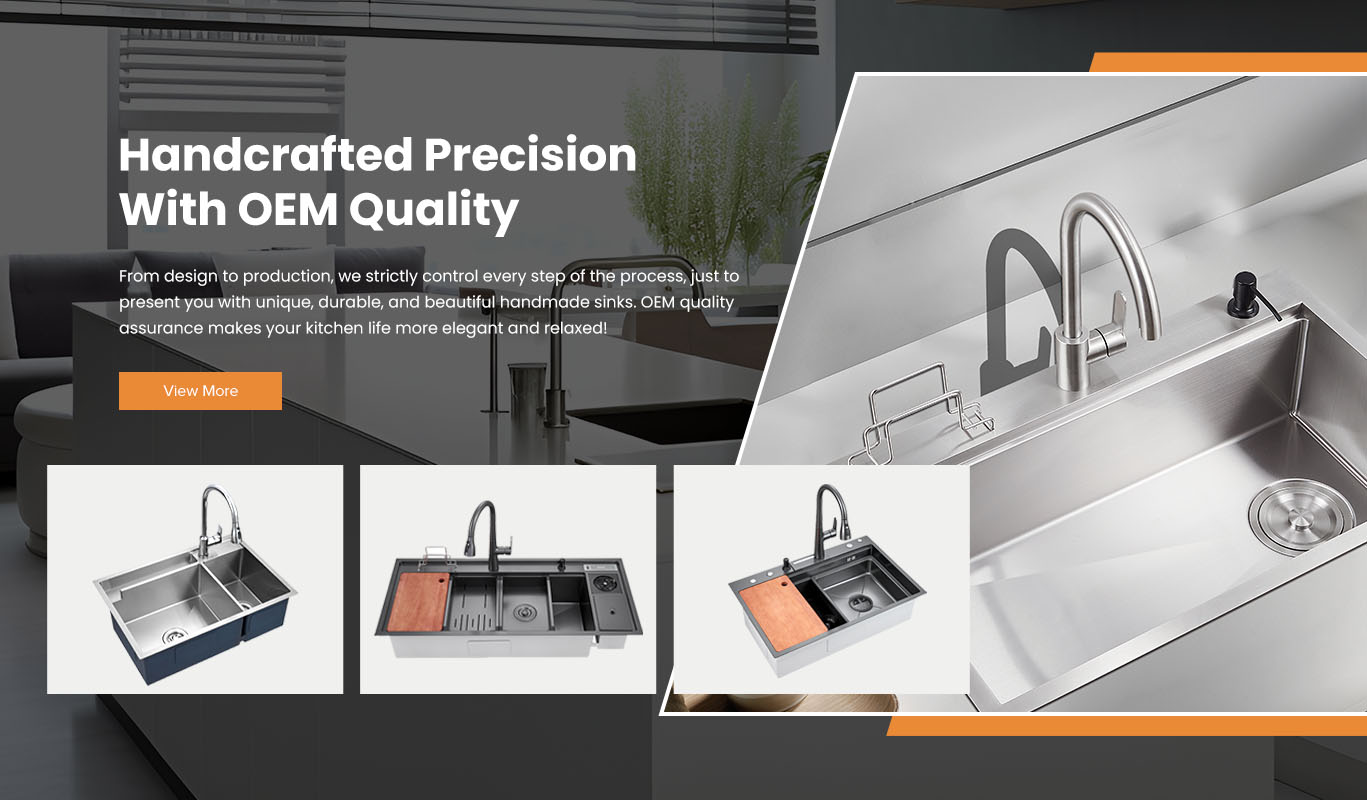
A deep stainless steel sink offers more washing capacity and splash control, while a shallow stainless steel sink provides easier access and faster daily cleaning. The better choice depends on kitchen usage and comfort needs.
The main difference between a deep stainless steel sink and a shallow stainless steel sink is the vertical space available inside the basin.
A deep stainless steel sink features a deeper bowl structure that provides more room for washing large cookware, soaking items, and handling higher cleaning volumes.
A shallow stainless steel sink has a reduced basin depth, making it easier to reach the bottom and providing a more comfortable working height for certain users.
From a manufacturing perspective, sink depth affects more than capacity. It influences product structure, water control, ergonomic performance, cabinet compatibility, and the overall kitchen experience.
A deep stainless steel sink increases the usable volume inside the basin, allowing users to complete more washing tasks in one area.
Key advantages include:
More space for large pots, pans, and kitchen equipment
Better capacity for soaking and cleaning tasks
Reduced water splashing outside the sink area
More flexibility when washing multiple items
Deep sink designs are especially valuable in kitchens where cooking activities involve large cookware or frequent manual washing.
For manufacturers, producing deeper sinks requires careful control of stainless steel thickness, bowl forming technology, reinforcement structure, and drainage performance to maintain durability.
A shallow stainless steel sink focuses on accessibility and ease of operation.
Its main benefits include:
Easier reach to the bottom of the basin
More comfortable use for shorter users or specific kitchen layouts
Faster cleaning of smaller items
Better compatibility with limited cabinet depths
Shallow sink designs are often suitable for compact kitchens, light-duty residential applications, and environments where convenience is prioritized over maximum capacity.
A well-designed shallow sink can still provide excellent performance when paired with proper width, material quality, and drainage design.
Large cookware is one of the most important factors when comparing sink depths.
A deep stainless steel sink provides better support for:
Large stock pots
Baking trays
Cooking containers
Oversized kitchen equipment
The additional vertical space allows these items to be placed inside the basin more naturally.
A shallow stainless steel sink can handle everyday dishes and smaller cookware efficiently, but larger items may require more movement during cleaning.
For households with frequent cooking activities, deeper sinks often provide a more convenient cleaning experience.
Water control is an important part of sink usability.
A deeper basin helps contain water movement by keeping washing activities farther below the countertop surface. This can reduce splashing onto surrounding areas.
This advantage is particularly useful when:
Washing large quantities of dishes
Cleaning vegetables and ingredients
Handling high-volume kitchen tasks
However, sink depth alone does not determine splash performance. Bowl shape, corner radius, faucet position, and user habits also influence the final experience.
Although deep sinks provide more capacity, shallow sinks can offer ergonomic advantages.
A shallow stainless steel sink may be preferable when:
Users prefer easier access
Daily washing tasks are relatively simple
Cabinet space is limited
Counter height makes deeper sinks uncomfortable
For kitchens focused on convenience and frequent quick cleaning, easier reach can be an important factor.
The most comfortable sink depth should match the user's physical habits and kitchen layout.
Modern kitchen design requires a balance between appearance, function, and space efficiency.
Deep stainless steel sinks are often selected for:
Premium residential kitchens
Open kitchen designs
Large cooking areas
Projects requiring high washing capacity
Shallow sinks can be suitable for:
Compact apartments
Minimalist kitchen layouts
Small preparation areas
Manufacturers develop different sink depths to meet different market preferences and installation conditions.
The quality of manufacturing directly affects how well different sink depths perform.
Important factors include:
| Manufacturing Factor | Influence on Cleaning Experience |
|---|---|
| Stainless steel grade | Improves corrosion resistance and durability |
| Material thickness | Supports basin strength |
| Bowl forming process | Maintains accurate dimensions |
| Surface treatment | Makes cleaning easier |
| Drainage design | Prevents water accumulation |
A deep sink requires strong structural control because larger basin dimensions create higher requirements for material performance.
A shallow sink requires precision manufacturing to maintain usability within a smaller structure.
Both deep and shallow stainless steel sinks can provide easy maintenance when properly designed.
Deep sinks offer more space for cleaning large items but may require users to reach further into the basin.
Shallow sinks are easier to access and may reduce bending during daily washing, especially for frequent light tasks.
Surface smoothness, drainage efficiency, and stainless steel quality often have a greater impact on maintenance than depth alone.
The right choice depends on kitchen application and user requirements.
A deep stainless steel sink is recommended when:
Large cookware is frequently cleaned
Higher washing capacity is required
Splash control is important
A premium kitchen solution is needed
A shallow stainless steel sink is recommended when:
Easy access is preferred
Kitchen space is limited
Daily cleaning tasks are lighter
Ergonomic convenience is important
For OEM and customized sink projects, manufacturers evaluate kitchen layouts, market preferences, and application requirements to determine the most suitable sink depth.
A deep stainless steel sink generally provides a better cleaning experience for users who need more capacity, larger washing space, and improved splash control. A shallow stainless steel sink offers better accessibility and convenience for lighter daily tasks.
The best choice depends on cookware size, cleaning habits, kitchen layout, and the overall product design.