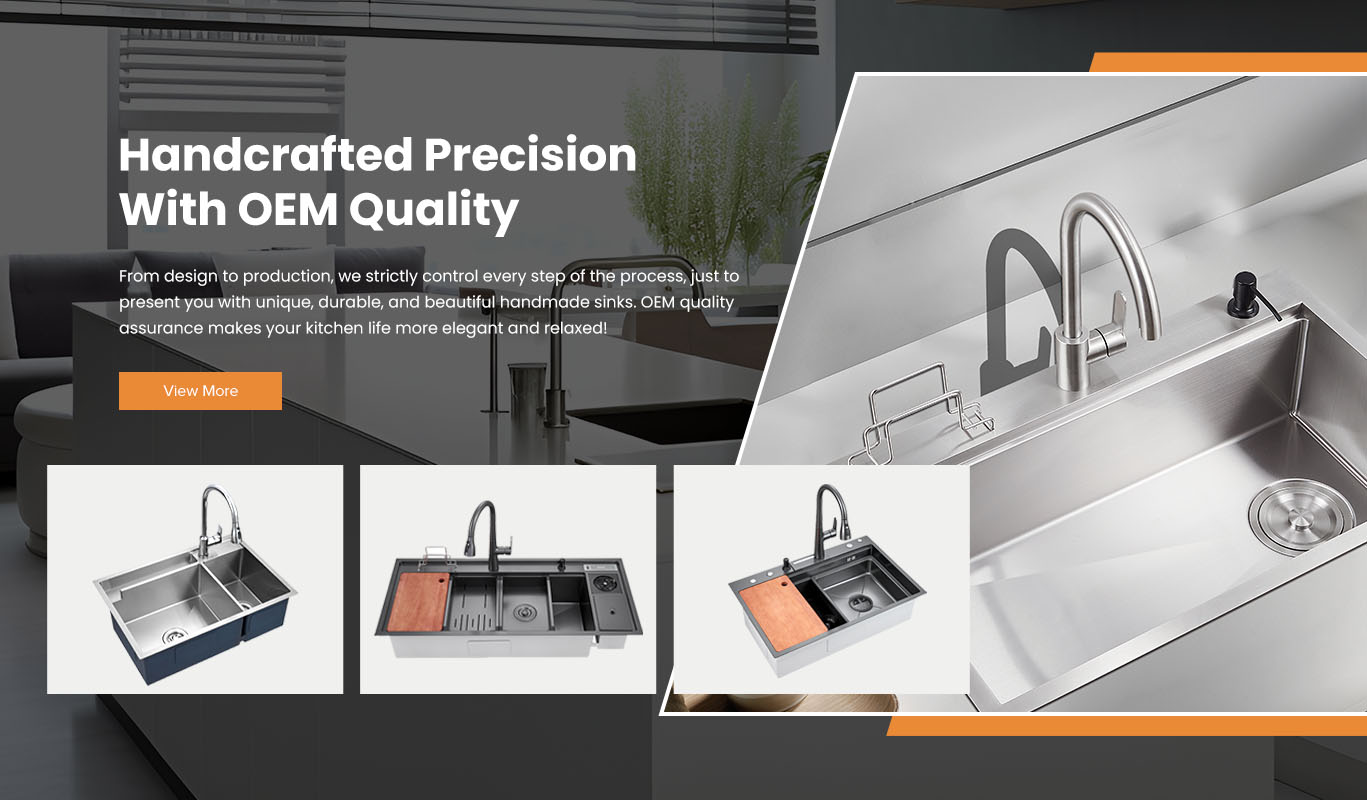
A sink without drainboard saves countertop space, while a kitchen sink with drainboard integrates drying space into the sink area. The better choice depends on kitchen layout and workflow needs.
The main difference between a kitchen sink with drainboard and a sink without drainboard is how the product uses surrounding kitchen space.
A kitchen sink with drainboard includes an extended flat area beside the basin for drying dishes, placing washed items, or preparing ingredients. This design combines washing and temporary storage functions within one unit.
A sink without drainboard focuses on maximizing the available sink basin and leaving more freedom for countertop arrangement. It is commonly selected for modern kitchens where users prefer a cleaner and more flexible countertop layout.
From a manufacturing perspective, the choice between these two designs involves more than appearance. Sink configuration affects countertop utilization, installation requirements, user habits, drainage performance, and overall kitchen efficiency.
A kitchen sink with drainboard uses the area around the sink more efficiently by adding a dedicated functional surface.
Its main advantages include:
Providing a built-in drying area for dishes and utensils
Reducing the need for separate drying racks
Keeping wet items away from other countertop areas
Creating a combined washing and drying workstation
For kitchens with limited countertop organization, a drainboard sink can reduce the number of additional accessories required.
This design is especially practical in traditional kitchens, rental properties, compact homes, and commercial environments where efficient use of every working area is important.
Manufacturers usually optimize drainboard designs by controlling slope angles, surface finishing, drainage channels, and overall dimensions to ensure water flows back into the sink effectively.
A sink without drainboard provides greater flexibility in countertop planning.
Its advantages include:
More available countertop space around the sink
Cleaner minimalist appearance
Easier integration with kitchen islands and modern cabinets
Greater freedom to use separate accessories
Many contemporary kitchens prioritize open countertop surfaces for food preparation and appliance placement. In these layouts, a sink without drainboard can provide a more streamlined appearance.
This design also allows users to select separate drying solutions based on their specific needs.
Small kitchens require careful management of every available surface.
A kitchen sink with drainboard can be highly practical because it combines multiple functions into one product. The integrated drying area reduces the need for extra countertop accessories.
However, the extended drainboard also increases the overall sink footprint. In very compact layouts, this may reduce available preparation space.
A sink without drainboard may be better when countertop flexibility is the priority. Users can install a smaller sink and allocate remaining space for food preparation.
The better choice depends on whether the kitchen needs an integrated drying solution or maximum open workspace.
For certain kitchen routines, a drainboard sink can improve workflow by creating a natural sequence:
Washing items inside the sink
Placing cleaned items on the drainboard
Allowing water to drain back into the basin
This reduces movement between different areas and helps keep countertops cleaner.
For households that frequently wash dishes manually, the drainboard becomes an extension of the sink rather than an additional feature.
In contrast, users who rely heavily on dishwashers may prefer a sink without drainboard because the drying area provides less practical value.
Commercial kitchens have different priorities compared with residential environments.
Kitchen sinks with drainboards are useful for:
Food preparation areas
Restaurants requiring manual washing
Catering operations
Commercial kitchens needing organized wet zones
The drainboard provides a convenient area for temporary placement of washed items or prepared ingredients.
Sinks without drainboards may be preferred in commercial environments where:
Countertop space must be maximized
Custom workstation layouts are required
Separate preparation surfaces are already available
Commercial sink selection should focus on workflow efficiency rather than a single design preference.
A drainboard sink requires precise manufacturing because the extended surface must maintain proper drainage and structural stability.
Important quality factors include:
| Manufacturing Factor | Impact on Performance |
|---|---|
| Stainless steel grade | Determines corrosion resistance |
| Drainboard slope design | Controls water flow efficiency |
| Surface finishing | Improves cleaning convenience |
| Welding quality | Ensures structural durability |
| Basin integration | Maintains overall product strength |
Professional sink manufacturers pay close attention to drainboard angle, edge treatment, and connection points to prevent water accumulation and improve long-term performance.
Both designs can provide easy maintenance when properly manufactured.
A sink with drainboard requires regular cleaning of the additional surface and drainage channels. However, it reduces water accumulation on countertops.
A sink without drainboard has a simpler structure and fewer surfaces to clean. Its maintenance process is usually more straightforward.
For users who prefer simple cleaning routines, a standard sink without drainboard may be more convenient. For users who value organized wet-area management, a drainboard sink offers practical benefits.
The right choice depends on kitchen layout, user habits, and available space.
A kitchen sink with drainboard is recommended when:
Drying space is needed
Manual washing is frequent
Countertop organization is important
A multifunctional sink area is preferred
A sink without drainboard is recommended when:
Maximum countertop flexibility is required
Modern minimalist design is preferred
Separate drying solutions are available
Kitchen space needs to remain open
For OEM and customized sink projects, manufacturers evaluate market preferences, installation conditions, and application scenarios to develop suitable sink configurations.
A sink without drainboard usually saves more countertop space because it uses a smaller footprint and allows flexible kitchen planning. A kitchen sink with drainboard can save functional space by combining washing and drying areas into one integrated solution.
The best design depends on whether the priority is maximizing open countertop area or improving workflow efficiency within the sink zone.