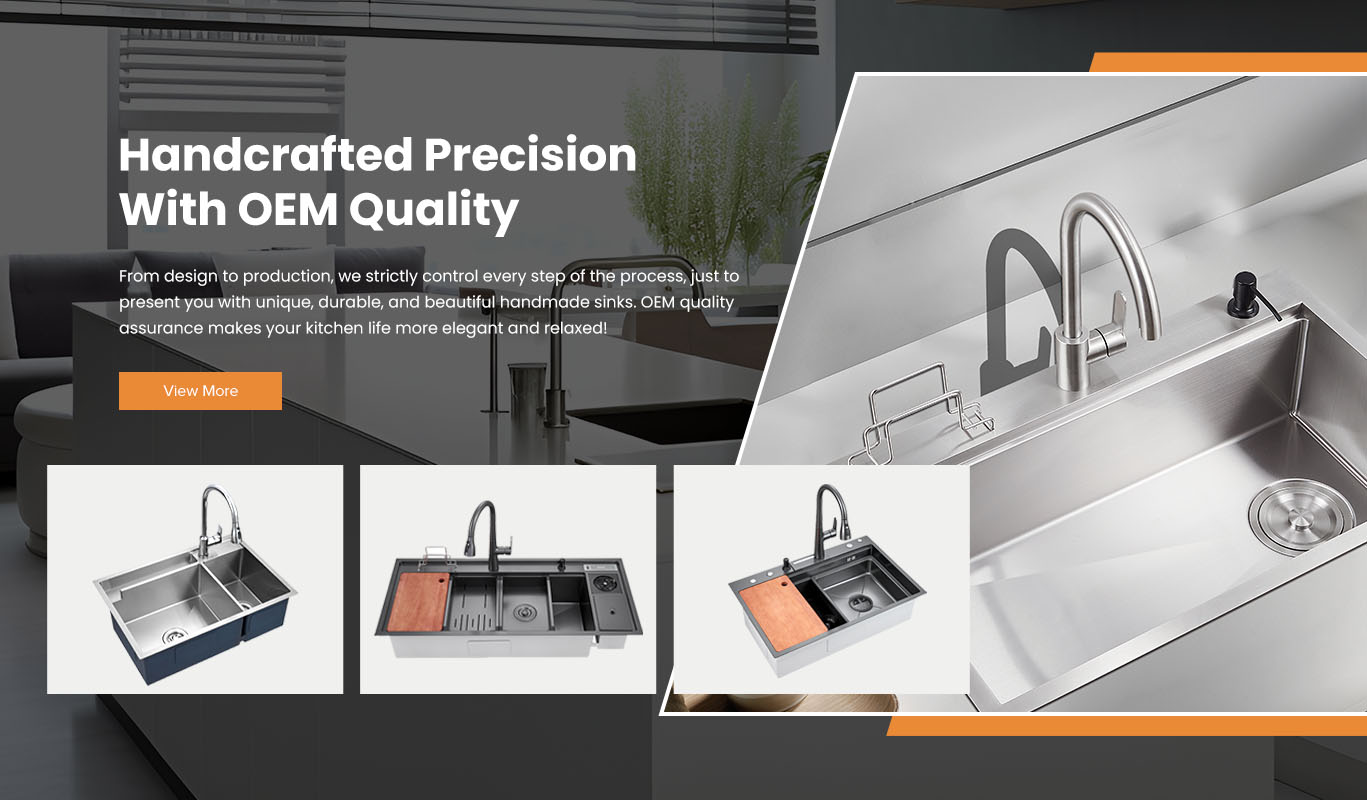
A large capacity sink is ideal for high-volume commercial cleaning, while a compact sink fits space-limited kitchens with lighter washing requirements. The right choice depends on workflow, space, and application needs.
The main difference between a large capacity sink and a compact sink is the relationship between washing capability and installation efficiency.
A large capacity sink is designed with a wider and deeper basin to handle more demanding cleaning tasks. It provides sufficient room for large cookware, food preparation containers, and multiple items during busy kitchen operations.
A compact sink uses a smaller footprint while maintaining essential washing functions. It is designed for commercial environments where available space is limited or where the washing workload does not require a large basin.
From a manufacturer’s perspective, selecting the right commercial sink size requires evaluating real application conditions, including cleaning frequency, kitchen workflow, equipment size, installation area, and long-term operating requirements.
Commercial kitchens often handle continuous food preparation and cleaning activities throughout the day. A large capacity sink helps improve efficiency by providing more usable washing space.
Major advantages include:
Accommodating large pots, pans, trays, and kitchen equipment
Reducing the number of washing cycles during peak hours
Supporting soaking and preparation tasks
Improving workflow efficiency in busy environments
Restaurants, hotels, catering facilities, and institutional kitchens commonly require larger sinks because their daily operations involve higher cleaning volumes than residential kitchens.
For professional sink manufacturers, large capacity sink production focuses on maintaining structural stability while increasing basin size. Material thickness, welding precision, drainage performance, and surface treatment all influence the final product quality.
A compact sink provides flexibility when space efficiency is more important than maximum washing capacity.
Its main benefits include:
Saving valuable countertop and floor space
Supporting smaller commercial kitchen layouts
Allowing additional washing stations to be installed
Simplifying installation in restricted areas
Compact sinks are commonly used in:
Small restaurants and cafes
Beverage preparation areas
Food service counters
Secondary cleaning stations
Although the basin capacity is smaller, compact sinks can provide excellent performance when the application requires targeted washing rather than large-scale cleaning.
For commercial kitchens with frequent cleaning demands, sink capacity directly affects productivity.
A large capacity sink usually performs better because it allows operators to:
Clean more equipment at one time
Handle oversized cookware more easily
Reduce workflow interruptions
Improve preparation and cleaning efficiency
A smaller sink may require additional handling steps when cleaning large items, which can increase operation time in busy environments.
However, choosing the largest available sink is not always the most efficient solution. A sink must match the actual kitchen workflow to avoid wasting installation space.
Compact sinks are valuable when commercial kitchens need efficient use of limited space.
They are suitable for:
Small food preparation areas
Satellite kitchen stations
Mobile kitchens
Commercial projects with multiple washing points
Instead of using one oversized sink, some commercial layouts benefit from multiple compact sinks placed near different working zones.
This approach can reduce movement distance and improve task efficiency for specific kitchen processes.
Sink selection should be based on how kitchen tasks are organized.
A large capacity sink supports centralized cleaning operations where many items are processed in one location.
A compact sink supports decentralized workflows where different areas handle different tasks.
| Comparison Factor | Large Capacity Sink | Compact Sink |
|---|---|---|
| Washing volume | Suitable for intensive cleaning | Suitable for moderate tasks |
| Large equipment cleaning | Excellent capacity | Limited capacity |
| Space requirement | Needs larger installation area | Fits restricted spaces |
| Workflow style | Centralized cleaning | Multiple task stations |
A professional kitchen design should consider both washing requirements and available space before selecting sink dimensions.
Commercial sinks must withstand frequent use, cleaning chemicals, heavy cookware, and long operating hours.
Key manufacturing factors include:
| Quality Factor | Performance Impact |
|---|---|
| Stainless steel grade | Improves corrosion resistance and service life |
| Material thickness | Enhances structural strength |
| Welding technology | Ensures stable construction |
| Surface finish | Supports easier cleaning |
| Drainage design | Improves water management |
Large capacity sinks require accurate manufacturing control because larger structures need stronger support against deformation.
Compact sinks also require precise production to maintain durability while achieving space-saving performance.
Maintenance requirements depend on design quality and usage conditions.
Large capacity sinks provide more working space, making it easier to clean large equipment. However, proper drainage design is essential to prevent standing water.
Compact sinks have smaller surfaces and may require less daily cleaning effort. They are often easier to integrate into smaller workstations.
For commercial environments, both designs can achieve reliable performance when manufactured with quality stainless steel, smooth surfaces, and effective drainage systems.
The best sink choice depends on operational requirements.
A large capacity sink is recommended when:
Large cookware is frequently cleaned
High-volume washing is required
Centralized cleaning efficiency is important
Kitchen space allows larger installation
A compact sink is recommended when:
Space optimization is necessary
Additional washing stations are required
Cleaning tasks are more specific
Flexible installation is preferred
For OEM and customized commercial sink projects, manufacturers typically analyze kitchen layouts, market requirements, and application conditions to provide suitable sink configurations.
A large capacity sink is more suitable for commercial kitchens requiring high-volume cleaning and large equipment handling, while a compact sink is better for operations that prioritize space efficiency and flexible installation.
The most suitable solution depends on kitchen workflow, available space, cleaning volume, and long-term operational requirements.