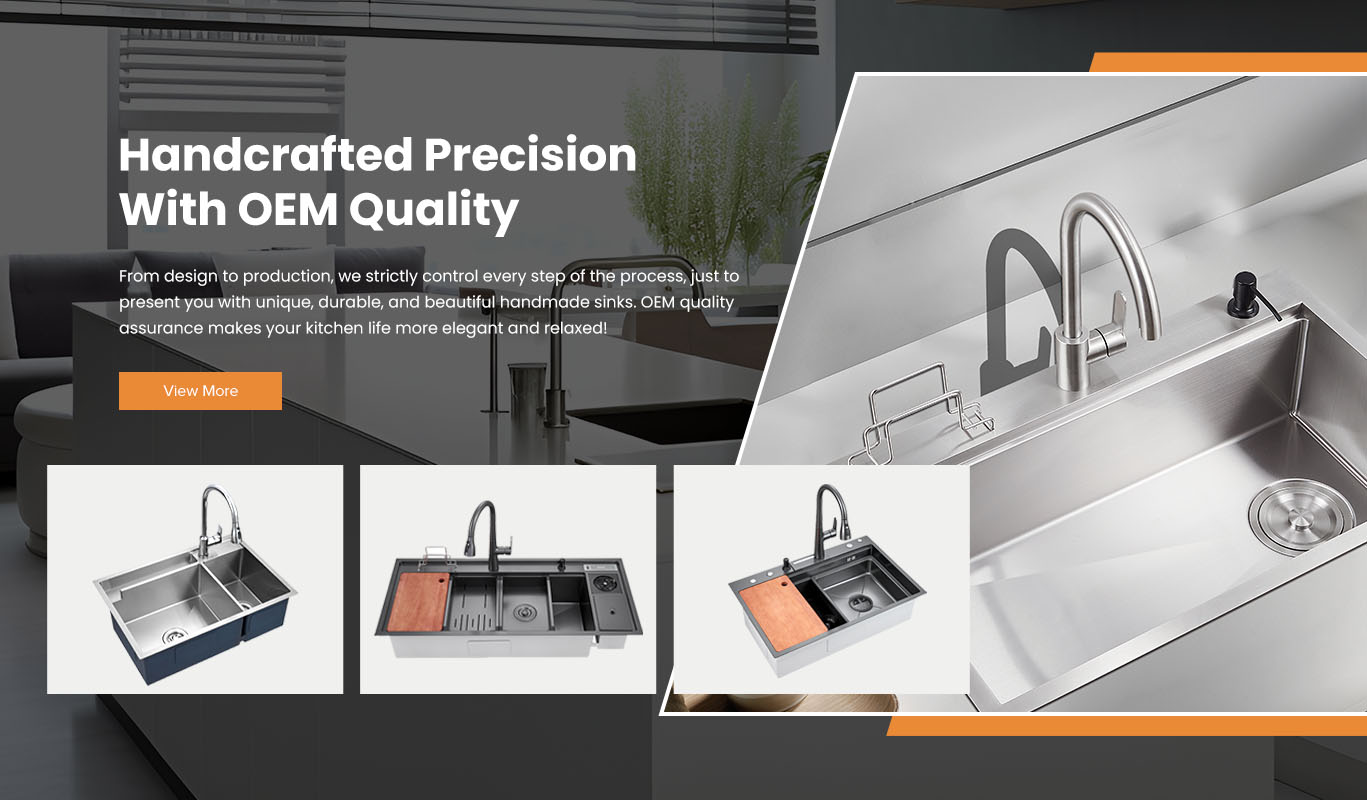
A large capacity sink is better for high-volume commercial cleaning, while a compact sink suits kitchens with limited space and lighter workloads. The right choice depends on workflow, kitchen size, and usage demands.
The main difference between a large capacity sink and a compact sink is the balance between washing volume and space efficiency.
A large capacity sink is designed with a wider and deeper basin, providing more room for cleaning large cookware, food containers, and multiple items at the same time. This structure supports high-efficiency operations in busy kitchen environments.
A compact sink focuses on saving installation space while maintaining essential washing functions. It is commonly used in commercial areas where countertop space is limited or where washing requirements are less intensive.
From a manufacturing perspective, commercial sink selection requires more than comparing size. Professional evaluation considers workflow speed, cleaning frequency, installation conditions, durability requirements, and long-term operational efficiency.
Commercial kitchens usually handle large volumes of food preparation and cleaning tasks. A large capacity sink provides additional working space that helps improve operational efficiency.
Key advantages include:
More space for large pots, pans, and cooking equipment
Higher washing capacity during peak operating periods
Easier soaking and cleaning of oversized items
Reduced need for repeated washing cycles
Restaurants, hotels, catering facilities, and food processing environments often require larger sink solutions because equipment size and cleaning volume are significantly higher than residential applications.
For manufacturers, large capacity sink production focuses on structural strength, material durability, drainage efficiency, and ergonomic design to ensure reliable performance under frequent use.
A compact sink provides flexibility where installation space is limited.
Its main advantages include:
Efficient use of limited countertop areas
Easier integration into smaller commercial layouts
Lower installation requirements
Suitable performance for basic washing tasks
Compact sinks are often used in:
Small cafes
Beverage stations
Food preparation areas with limited space
Mobile or temporary kitchen environments
Although the washing area is smaller, a well-designed compact sink can still provide reliable performance when matched with the correct application.
High-volume kitchens usually require equipment that supports continuous workflows.
A large capacity sink is generally more suitable because it allows staff to:
Clean more items in one operation
Handle larger cookware without restrictions
Reduce interruptions during busy periods
Improve overall kitchen productivity
In commercial environments, sink size directly affects workflow efficiency. A sink that is too small may increase cleaning time and create unnecessary operational limitations.
However, the largest sink is not always the best solution. The available installation area and kitchen layout must also be considered.
Compact sinks provide advantages when space efficiency is the priority.
They are suitable for applications such as:
Small food service operations
Secondary preparation areas
Beverage counters
Limited-space commercial kitchens
A compact sink allows businesses to maintain essential washing functions without sacrificing valuable working space.
For commercial projects with multiple stations, smaller sinks can also be strategically placed to support specific tasks rather than relying on one large central sink.
Commercial kitchen efficiency depends heavily on workflow organization.
A large capacity sink supports centralized cleaning operations where large quantities of items need to be processed in one location.
A compact sink supports distributed workflows where different stations perform specific tasks.
The selection process should consider:
| Workflow Factor | Large Capacity Sink | Compact Sink |
|---|---|---|
| Cleaning volume | Suitable for high-volume operations | Suitable for lighter tasks |
| Large cookware handling | Excellent performance | Limited capacity |
| Space efficiency | Requires more installation area | Fits smaller layouts |
| Multiple station use | Works as a central washing area | Works well as a dedicated station |
Choosing the correct sink size helps improve productivity and prevents inefficient use of commercial kitchen space.
Commercial sinks must withstand frequent cleaning, heavy cookware handling, and continuous operation.
Professional manufacturers evaluate:
| Quality Factor | Importance |
|---|---|
| Stainless steel grade | Provides corrosion resistance and service life |
| Material thickness | Improves structural stability |
| Welding quality | Ensures long-term strength |
| Surface finishing | Supports easy cleaning |
| Drainage design | Prevents water accumulation |
Large capacity sinks require additional structural control because larger dimensions create higher demands on material strength and manufacturing accuracy.
Compact sinks also require precise production to maintain durability while achieving space-saving designs.
Maintenance depends on usage conditions and product design.
Large capacity sinks provide more working space, which can simplify cleaning of large equipment. However, they require proper drainage and regular surface care due to their larger area.
Compact sinks are easier to manage in smaller stations because of their reduced size and simpler installation.
For both designs, high-quality stainless steel materials, smooth surfaces, and reliable drainage systems are essential for long-term performance.
The right choice depends on operational requirements rather than size alone.
A large capacity sink is recommended when:
Large cookware is frequently cleaned
High-volume washing is required
Kitchen workflow depends on centralized cleaning
Maximum washing efficiency is important
A compact sink is recommended when:
Installation space is limited
The kitchen requires additional washing stations
Daily cleaning volume is moderate
Space optimization is a priority
For OEM and customized commercial sink projects, manufacturers usually evaluate application scenarios, kitchen layouts, and market requirements before recommending the most suitable configuration.
A large capacity sink is generally more suitable for commercial kitchens with high cleaning volumes and large equipment, while a compact sink is better for businesses that prioritize space efficiency and flexible installation.
The best commercial sink solution depends on kitchen workflow, available space, cleaning requirements, and long-term operational goals.