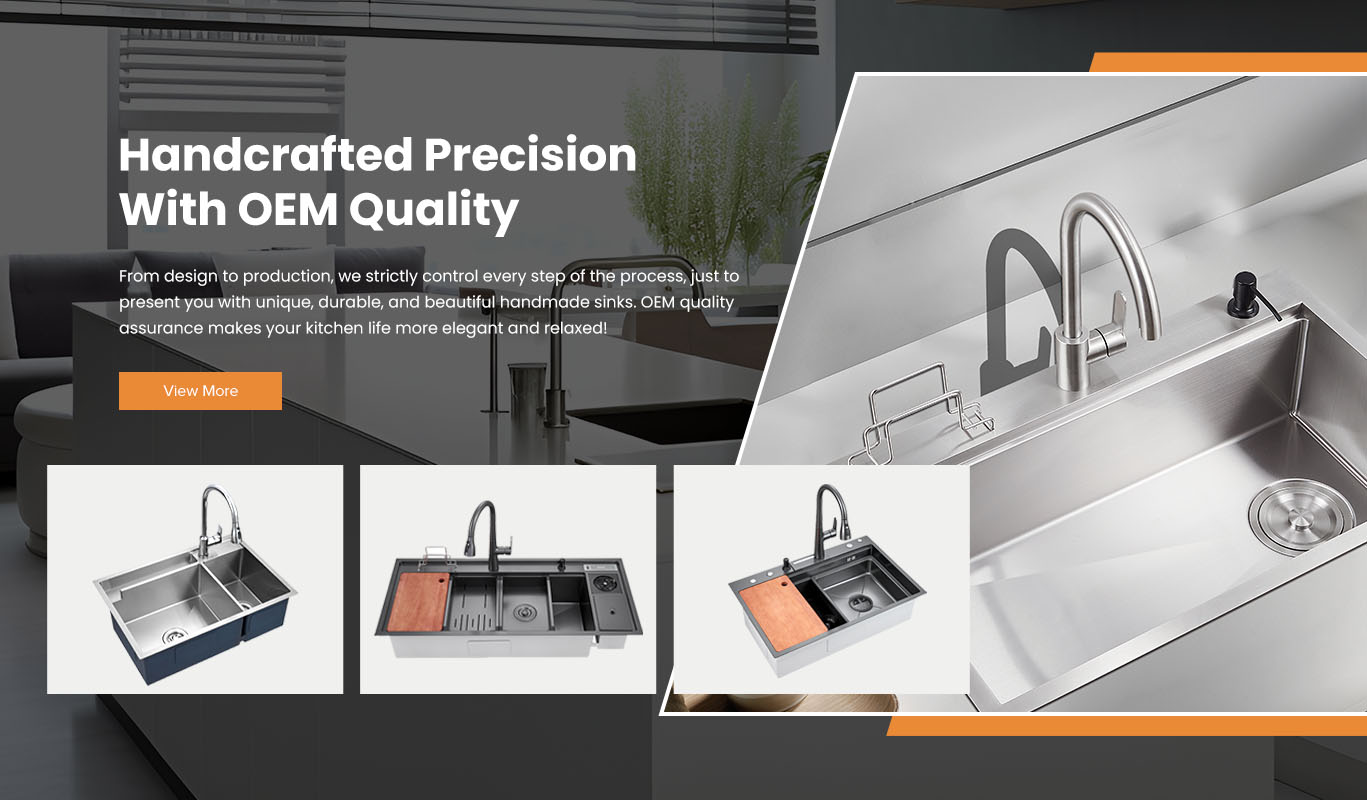
Choosing a good gauge for a stainless steel sink requires understanding how thickness affects performance, durability, and product application. The best gauge is not always the thickest option. A suitable stainless steel thickness should match the sink size, usage intensity, design requirements, and expected service life.
In stainless steel sink manufacturing, gauge represents the thickness of the stainless steel sheet, and the numbering system works in reverse:
A lower gauge number means thicker stainless steel.
For example, 16 gauge stainless steel is approximately 1.5–1.6 mm thick, while 18 gauge stainless steel is around 1.2 mm thick. (Ruvati USA)
As a professional stainless steel sink manufacturer, SHUNHAN evaluates gauge together with stainless steel grade, forming technology, surface treatment, and production quality control to provide customized OEM and ODM sink solutions. SHUNHAN Stainless Steel Sink Manufacturer
Gauge determines the thickness of the raw stainless steel material before it becomes a finished sink.
Common stainless steel sink gauges include:
| Gauge | Approximate Thickness | Typical Application |
|---|---|---|
| 16 Gauge | About 1.5–1.6 mm | Premium kitchens and heavy-use applications |
| 18 Gauge | About 1.2–1.3 mm | Standard residential kitchens |
| 20 Gauge | About 1.0 mm | Lightweight applications |
| 22 Gauge | About 0.8 mm | Entry-level products |
A thicker stainless steel sheet usually provides:
Better dent resistance
Higher structural stability
Reduced vibration
Improved sound performance
Stronger premium feel
However, gauge is only one part of sink quality. Material grade, welding accuracy, surface finishing, and manufacturing consistency also influence final performance.
For most kitchen sink applications, 16 gauge and 18 gauge stainless steel are considered the best choices because they provide a strong balance between strength, durability, and cost efficiency.
Professional sink selection should consider:
| Application | Recommended Gauge |
|---|---|
| Luxury kitchen projects | 16 Gauge |
| Large workstation sinks | 16 Gauge |
| Commercial kitchens | 16 Gauge |
| Standard residential kitchens | 18 Gauge |
| Cost-focused projects | 18 Gauge |
A good gauge depends on the actual usage scenario.
For example:
A large single bowl sink needs stronger structural support.
A compact kitchen sink may not require maximum thickness.
A commercial sink requires higher impact resistance.
The correct gauge helps achieve reliable performance without unnecessary material cost.
A 16 gauge stainless steel sink is usually selected for premium and heavy-use applications.
The thicker stainless steel sheet helps reduce:
Denting
Bowl deformation
Surface vibration
Edge movement
This makes it suitable for:
Large farmhouse sinks
Deep workstation sinks
Heavy cookware usage
Commercial-style kitchens
Thicker stainless steel naturally absorbs vibration more effectively.
Professional manufacturers may combine 16 gauge material with:
Sound deadening pads
Anti-condensation coatings
Reinforced structures
These improvements reduce noise from:
Running water
Metal cookware
Dish impact
A thicker sink provides a stronger physical feeling and is often preferred for high-end kitchen projects.
An 18 gauge stainless steel sink is one of the most common choices for residential kitchens.
It provides:
Good durability
Stable production performance
Competitive pricing
Lower transportation weight
Suitable daily performance
Many residential kitchen projects choose 18 gauge because it balances quality expectations and cost control.
| Feature | 16 Gauge | 18 Gauge |
|---|---|---|
| Thickness | About 1.5 mm | About 1.2 mm |
| Strength | Higher | Good |
| Dent resistance | Excellent | Reliable |
| Material usage | Higher | Moderate |
| Best application | Premium projects | Standard projects |
A good stainless steel sink requires both suitable thickness and reliable material.
The main factors affecting sink performance include:
| Factor | Influence |
|---|---|
| Stainless steel grade | Corrosion resistance |
| Gauge thickness | Structural strength |
| Surface finish | Appearance and maintenance |
| Welding quality | Leakage prevention |
| Manufacturing accuracy | Product consistency |
304 stainless steel is widely used for kitchen sinks because it provides:
Good corrosion resistance
Excellent forming ability
Stable surface performance
Long service life
304 stainless steel belongs to the austenitic stainless steel family and is commonly recognized for corrosion resistance and weldability.
A thicker sink made from poor material may not outperform a properly manufactured sink using high-quality stainless steel.
Gauge specifications only create value when the production process is controlled.
A professional stainless steel sink manufacturing process includes:
Stainless steel material inspection
Sheet cutting
Deep drawing or forming
Welding
Grinding
Surface brushing
Cleaning treatment
Leakage testing
Final quality inspection
| Production Stage | Quality Control Focus |
|---|---|
| Material inspection | Verify stainless steel grade |
| Forming | Maintain sink structure |
| Welding | Prevent leakage |
| Grinding | Ensure smooth edges |
| Surface finishing | Keep consistent appearance |
| Final inspection | Confirm product performance |
For thinner materials, manufacturing accuracy becomes even more important because incorrect processing can affect stability.
When developing customized stainless steel sinks, gauge selection should happen during the design stage.
A professional OEM and ODM process includes:
Manufacturers evaluate:
Sink size
Bowl design
Installation method
Usage environment
Target market
The factory confirms:
Stainless steel thickness
Reinforcement structure
Surface finish
Drainage design
Testing includes:
Material inspection
Thickness measurement
Water leakage testing
Appearance inspection
SHUNHAN provides customized stainless steel sink solutions with different sizes, structures, finishes, and specifications for global kitchen applications. SHUNHAN Products
Gauge is only a specification. Manufacturing capability determines whether the specification becomes a reliable product.
A professional stainless steel sink manufacturer controls:
Stainless steel sourcing
Material thickness
Forming technology
Welding quality
Surface finishing
Production consistency
A trader usually provides existing products, while a manufacturer can adjust:
Gauge requirements
Sink dimensions
Surface treatment
Packaging solutions
For bulk supply projects, factory control helps maintain consistent quality across every production batch.
When selecting stainless steel sinks for large projects, consider:
| Evaluation Item | Importance |
|---|---|
| Gauge selection | Matches application needs |
| Stainless steel grade | Ensures durability |
| Production capacity | Supports stable delivery |
| Quality inspection | Reduces defects |
| Packaging standards | Protects products |
A reliable supplier should provide stable production quality instead of only focusing on low pricing.
Before selecting a stainless steel sink manufacturer, evaluate:
| Checkpoint | What To Confirm |
|---|---|
| Gauge | Is thickness suitable for usage? |
| Material | Is stainless steel grade verified? |
| Manufacturing | Are forming and welding controlled? |
| Surface | Is finish consistent? |
| Testing | Are leakage tests completed? |
| OEM/ODM | Can specifications be customized? |
| Export | Are standards and documentation prepared? |
Important export considerations include:
Material documentation
Packaging protection
Delivery capability
Market compliance