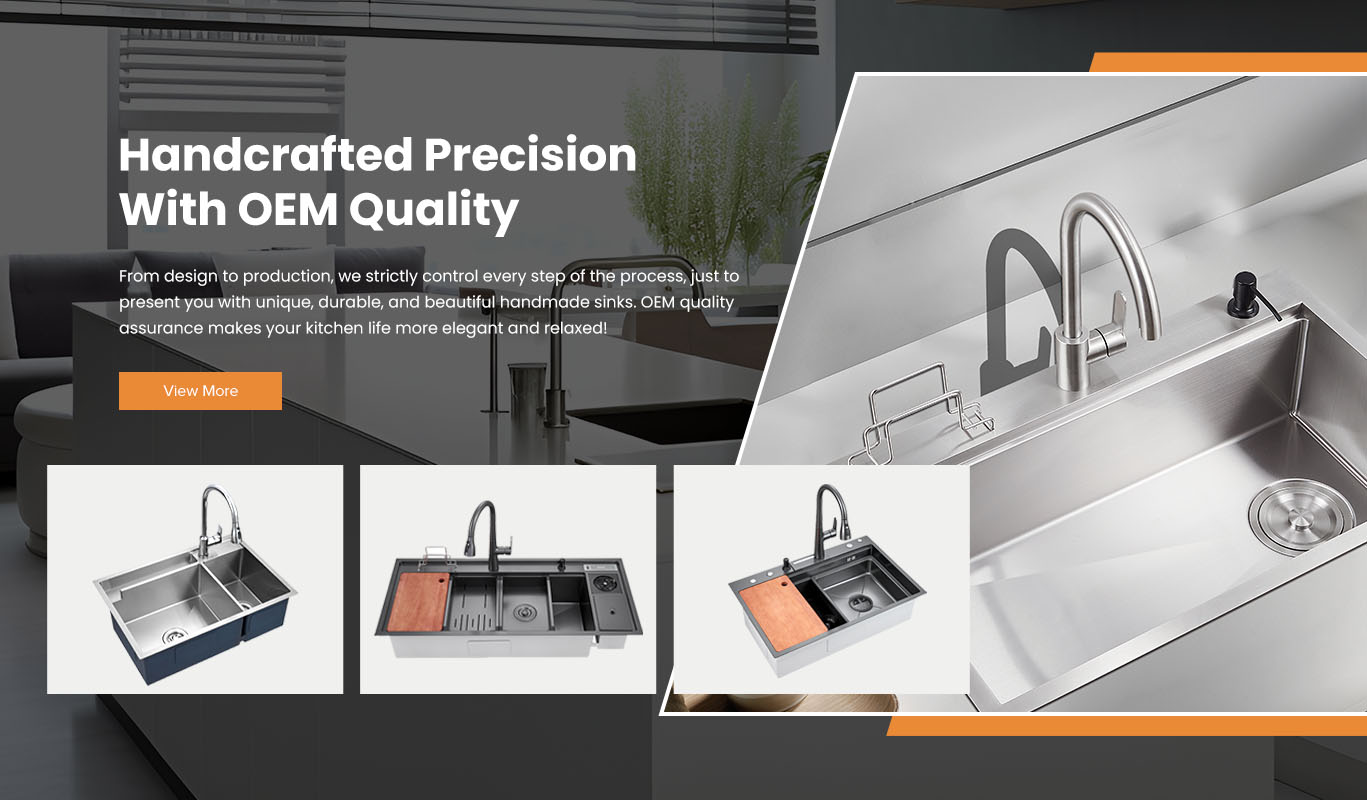
Choosing the right gauge is one of the most important decisions when developing or purchasing a stainless steel sink. Gauge determines the thickness of the stainless steel sheet used during production, which directly affects durability, noise control, structural strength, and product positioning.
However, a common misunderstanding is that a higher gauge means better quality. In stainless steel sink manufacturing, the opposite is true:
Lower gauge number = thicker stainless steel
For example, a 16 gauge stainless steel sink is thicker than an 18 gauge sink. A 16 gauge sheet is approximately 1.5 mm thick, while an 18 gauge sheet is around 1.2 mm thick. (SHUNHAN)
As a professional stainless steel sink manufacturer, SHUNHAN evaluates gauge selection together with material grade, sink structure, surface finish, and production requirements to provide suitable OEM and ODM solutions. (SHUNHAN)
Gauge refers to the thickness measurement of stainless steel sheets before they are formed into sinks.
The most common stainless steel sink gauges include:
| Gauge | Approximate Thickness | Common Application |
|---|---|---|
| 16 Gauge | 1.5–1.6 mm | Premium residential, commercial projects |
| 18 Gauge | 1.2–1.3 mm | Standard residential kitchens |
| 20 Gauge | Around 1.0 mm | Budget applications |
| 22 Gauge | Around 0.8 mm | Light-duty products |
In most quality kitchen sink applications, 16 gauge and 18 gauge are considered the preferred options because they provide a balance between durability, production efficiency, and cost control. (SHUNHAN)
A 16 gauge stainless steel sink uses thicker material, providing stronger structural performance.
Main advantages include:
Better resistance to dents
More stable bowl structure
Reduced vibration
Lower operating noise
Premium product feel
A thicker steel sheet is especially valuable for:
Large single bowl sinks
Heavy-use kitchens
Luxury residential projects
Commercial food preparation areas
| Feature | 16 Gauge Sink |
|---|---|
| Thickness | About 1.5 mm |
| Durability | Excellent |
| Noise control | Better vibration absorption |
| Positioning | Premium market |
For projects where customers expect a heavier, stronger sink, 16 gauge is usually the preferred specification.
An 18 gauge stainless steel sink provides a practical balance between performance and cost.
Advantages include:
Reliable daily durability
Easier transportation
Competitive pricing
Wide application range
It is commonly used for:
Residential kitchens
Apartment projects
Standard renovation projects
High-volume supply programs
| Feature | 18 Gauge Sink |
|---|---|
| Thickness | About 1.2 mm |
| Durability | Very good |
| Cost efficiency | Higher |
| Application | Mainstream kitchens |
For many kitchen projects, 18 gauge provides enough strength while maintaining better supply efficiency. (SHUNHAN)
The better choice depends on the project requirements.
| Comparison | 16 Gauge | 18 Gauge |
|---|---|---|
| Thickness | Higher | Lower |
| Strength | Excellent | Good |
| Dent resistance | Better | Good |
| Weight | Heavier | Lighter |
| Cost | Higher | More competitive |
| Best for | Premium projects | Standard applications |
The decision should not be based only on thickness. A high-quality 18 gauge sink with good forming technology, welding control, and surface finishing can still provide excellent performance.
Gauge alone does not define stainless steel sink quality.
A complete evaluation should include:
| Factor | Impact |
|---|---|
| Stainless steel grade | Corrosion resistance |
| Gauge thickness | Structural strength |
| Forming technology | Shape stability |
| Welding quality | Leakage prevention |
| Surface finish | Appearance and maintenance |
304 stainless steel is widely used in kitchen sinks because it offers a strong balance of corrosion resistance, durability, and processing performance.
Typical 304 stainless steel contains:
| Element | Function |
|---|---|
| Chromium | Creates corrosion-resistant passive layer |
| Nickel | Improves corrosion resistance and forming ability |
SHUNHAN focuses on 304 stainless steel sink manufacturing and combines suitable material selection with professional production technology. (SHUNHAN)
A professional manufacturer does not simply select a gauge number. The thickness must match the sink structure and production process.
The manufacturing process includes:
Stainless steel sheet inspection
Cutting
Deep drawing or forming
Welding
Grinding
Surface brushing
Cleaning
Leakage testing
Final inspection
Each stage affects the final performance.
| Production Stage | Quality Control Focus |
|---|---|
| Material inspection | Verify stainless steel grade and thickness |
| Forming process | Maintain structural strength |
| Welding | Prevent cracks and leakage |
| Surface treatment | Ensure consistent appearance |
| Final inspection | Confirm product quality |
A thicker gauge only creates value when supported by stable manufacturing capability.
For customized stainless steel sinks, gauge selection should be determined during the product development stage.
A professional OEM and ODM process considers:
Manufacturers evaluate:
Target market
Product price range
Usage environment
Expected lifespan
Important factors include:
Sink size
Bowl depth
Installation method
Edge structure
The factory confirms:
Material availability
Forming capability
Surface finish requirements
Packaging specifications
SHUNHAN provides customized stainless steel sink solutions, supporting different designs, thickness requirements, finishes, and project applications. (SHUNHAN)
When selecting stainless steel sinks, gauge is only meaningful when the supplier has real manufacturing capability.
A professional manufacturer can control:
Stainless steel sourcing
Thickness accuracy
Forming technology
Welding quality
Surface treatment
Batch consistency
A trader may only provide standard gauge options, while a manufacturer can adjust thickness, structure, and finishing according to project requirements.
For bulk supply, production consistency is often more important than choosing the thickest material.
Different supply projects require different gauge strategies.
| Project Type | Recommended Gauge Direction |
|---|---|
| Luxury residential | 16 gauge |
| Commercial kitchens | 16 gauge |
| Standard homes | 18 gauge |
| Cost-sensitive projects | 18 gauge |
When planning bulk orders, consider:
Material cost
Shipping weight
Market positioning
Customer expectations
Long-term durability
A professional factory can help balance performance and cost instead of simply increasing material thickness.
Before choosing a stainless steel sink supplier, evaluate:
| Checkpoint | Question |
|---|---|
| Material | Is 304 stainless steel used? |
| Thickness | Is gauge measurement controlled? |
| Production | Is forming technology stable? |
| Surface | Is finishing consistent? |
| Inspection | Are leakage and appearance tests included? |
| Supply | Can quality remain stable in bulk production? |
For international projects, manufacturers should also consider:
Material documentation
Production standards
Packaging requirements
Product consistency
Market-specific expectations
A reliable manufacturing process helps reduce quality issues during international supply.