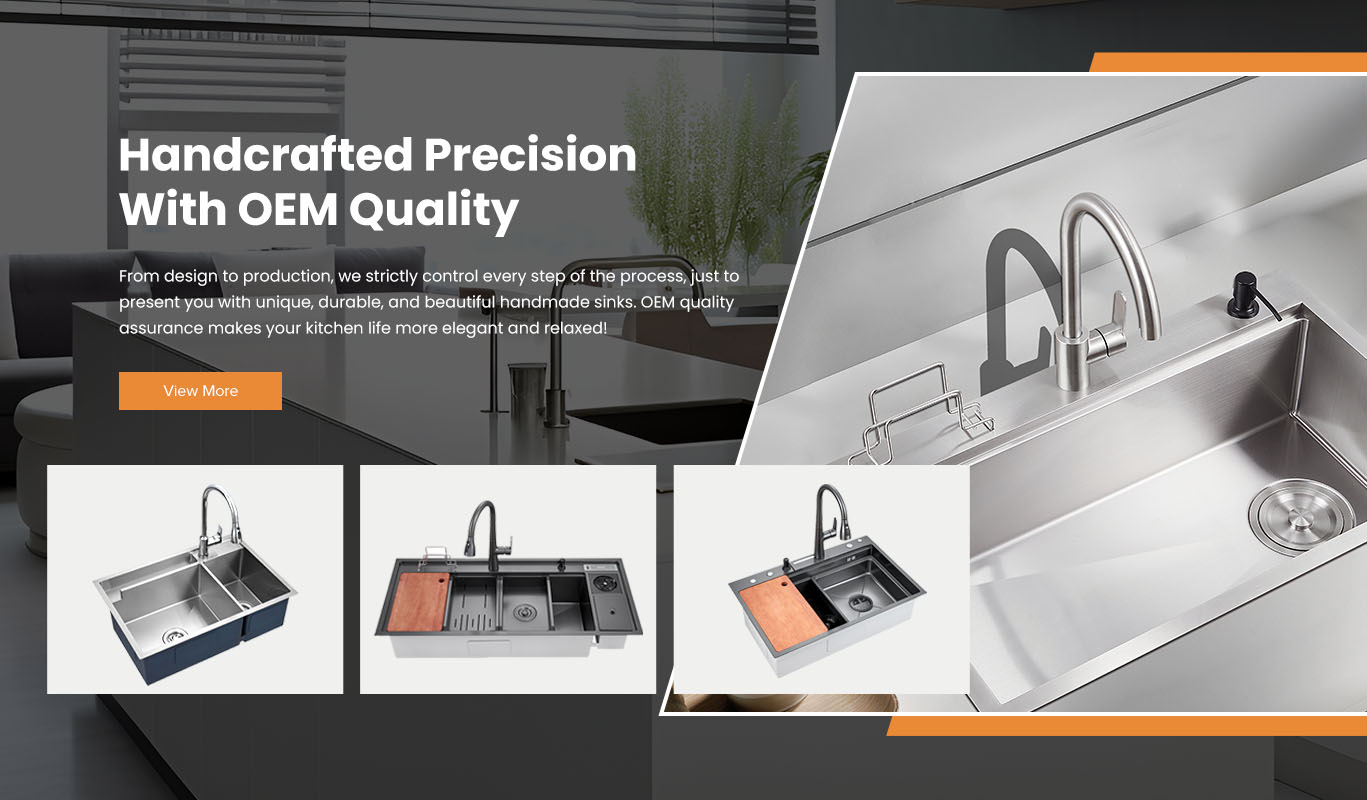
A 16 gauge sink provides higher strength, better impact resistance, and a more solid premium feel, while an 18 gauge sink offers excellent durability with broader market flexibility. The better choice depends on kitchen positioning and performance requirements.
The main difference between a 16 gauge sink and an 18 gauge sink is the thickness of the stainless steel material used during manufacturing.
A 16 gauge sink uses thicker stainless steel, providing increased structural strength, improved resistance to impact, and a more substantial feel during use.
An 18 gauge sink uses slightly thinner stainless steel while maintaining strong durability and corrosion resistance for many residential and commercial applications.
From a manufacturer’s perspective, thickness selection is not simply about choosing a heavier material. It involves balancing product positioning, manufacturing requirements, installation conditions, and customer expectations.
Premium kitchens often require products that deliver both visual quality and long-term performance.
A 16 gauge sink provides advantages such as:
Stronger structural stability
Better resistance to dents and impacts
More solid user experience
Reduced vibration during operation
The thicker stainless steel structure helps the sink maintain its shape when handling:
Heavy cookware
Large pots and pans
Frequent washing tasks
High-use kitchen activities
This makes 16 gauge sinks suitable for:
Luxury residential kitchens
High-end renovation projects
Premium kitchen brands
Designer interior applications
An 18 gauge sink provides a strong balance between durability, appearance, and cost efficiency.
Its main advantages include:
Reliable structural strength
Good corrosion resistance
Suitable weight for installation
Wide application compatibility
18 gauge sinks are commonly used for:
Modern residential kitchens
Commercial kitchen projects
Apartment developments
Premium standard kitchen solutions
For many customers, 18 gauge stainless steel provides sufficient performance without increasing product cost significantly.
Material thickness can influence how customers perceive product quality.
A 16 gauge sink often creates a more premium experience because:
The basin feels more solid
Vibration is reduced
Sound performance is improved
The product feels more substantial
An 18 gauge sink can also deliver a premium experience when combined with:
High-quality stainless steel
Precise manufacturing
Effective sound insulation
Refined surface finishing
Premium perception depends on the complete product design, not thickness alone.
Yes. Stainless steel thickness is an important factor affecting structural durability.
A 16 gauge sink provides additional advantages in:
Impact resistance
Structural rigidity
Long-term shape stability
Heavy-duty applications
An 18 gauge sink provides reliable durability for most daily kitchen environments.
However, actual service life also depends on:
Stainless steel grade
Manufacturing quality
Welding technology
Installation method
Maintenance practices
Thicker stainless steel generally helps reduce vibration and operating noise.
A 16 gauge sink provides advantages through:
Lower vibration during water impact
More stable basin structure
Stronger sound absorption capability
An 18 gauge sink can also achieve good noise performance through:
Sound insulation coatings
Reinforced structures
Proper installation methods
Manufacturers often combine thickness selection with noise reduction technologies to improve overall user experience.
Premium kitchen projects often focus on durability, appearance, and long-term value.
| Thickness | Design Value | Suitable Applications |
|---|---|---|
| 16 Gauge | Maximum strength and premium feel | Luxury kitchens and high-end projects |
| 18 Gauge | Balanced performance and flexibility | Premium residential and commercial kitchens |
A 16 gauge sink can support premium positioning by emphasizing quality and durability.
An 18 gauge sink provides broader application flexibility while maintaining strong performance.
Producing thicker stainless steel sinks requires precise manufacturing control.
Important quality factors include:
| Manufacturing Factor | Performance Impact |
|---|---|
| Stainless steel grade | Determines corrosion resistance |
| Material thickness | Supports structural strength |
| Forming accuracy | Maintains basin shape |
| Welding quality | Improves durability |
| Surface finishing | Enhances appearance |
Professional manufacturers control each stage to ensure consistent quality in both 16 gauge and 18 gauge sinks.
OEM projects should consider brand positioning and target customers.
A 16 gauge sink is suitable for OEM projects requiring:
Luxury product positioning
Higher perceived value
Heavy-duty performance
Premium customer targeting
An 18 gauge sink is suitable for OEM projects requiring:
Strong performance with cost balance
Wider market applications
Stable production efficiency
Competitive product positioning
Manufacturers can help select the appropriate thickness according to market requirements.
Not necessarily.
A thicker sink provides advantages in strength and premium feel, but the best choice depends on the application.
An 18 gauge sink may be more suitable when:
Weight limitations exist
Cost efficiency is important
Standard premium performance is sufficient
A 16 gauge sink is more suitable when:
Maximum durability is required
Premium positioning is important
Heavy usage is expected
The correct choice should match actual project requirements.
The right thickness depends on kitchen requirements and customer expectations.
A 16 gauge sink is recommended when:
Premium quality is the priority
Strong structural performance is required
Luxury kitchen applications are targeted
Long-term durability matters
An 18 gauge sink is recommended when:
Balanced performance is preferred
Broader application is needed
Cost control is important
Reliable durability is sufficient
Choosing the appropriate thickness helps achieve the right balance between quality, performance, and market positioning.
A 16 gauge sink is generally better for premium kitchens because it provides stronger durability, better impact resistance, and a more substantial user experience. An 18 gauge sink offers excellent performance with greater flexibility and cost balance.
The ideal choice depends on kitchen positioning, usage requirements, customer expectations, and overall product strategy.