A custom handmade sink is better for OEM projects requiring differentiation and flexibility, while a standard pressed sink suits large-volume production with consistent specifications. The right choice depends on project goals and market positioning.
The main difference between a custom handmade sink and a standard pressed sink is the manufacturing approach and level of product customization.
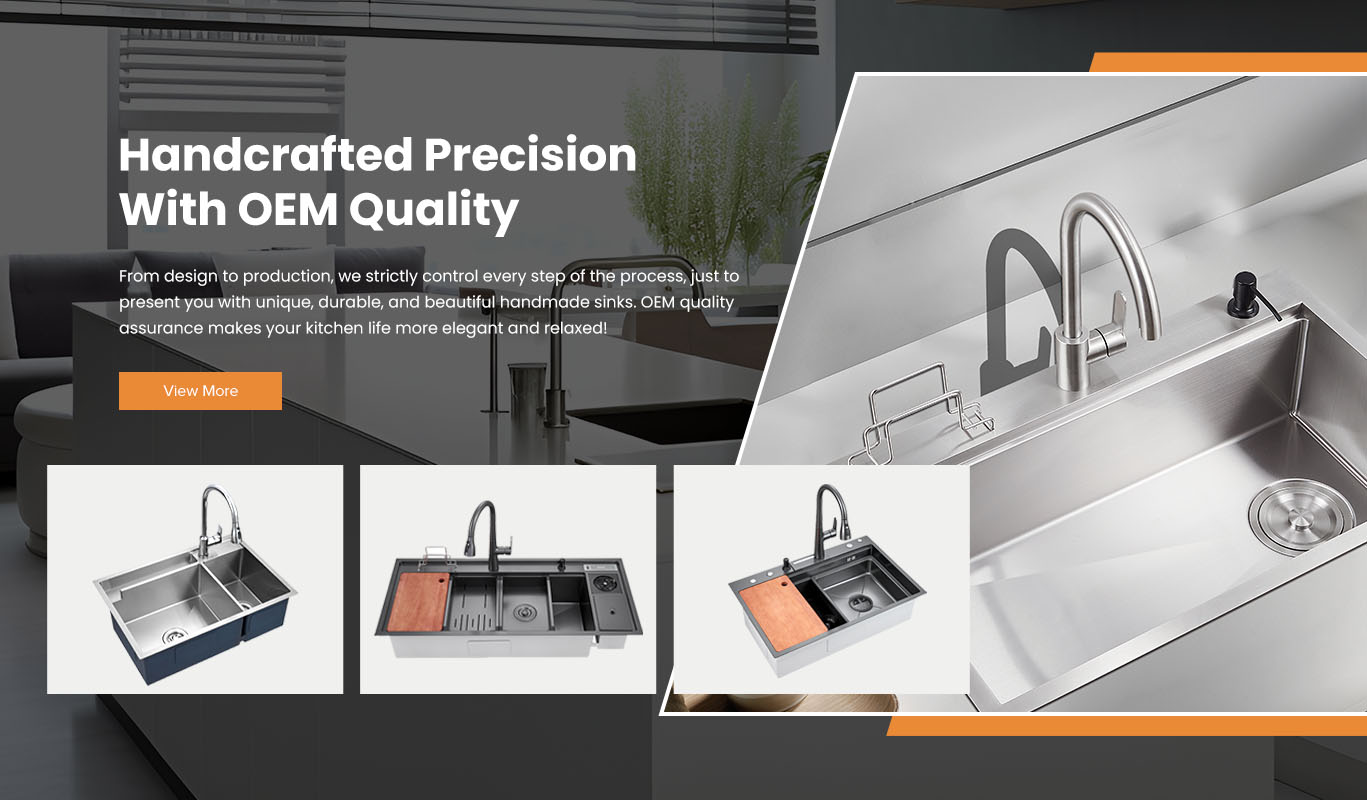
A custom handmade sink is produced through fabrication processes such as cutting, bending, welding, grinding, and finishing. This method allows manufacturers to adjust product dimensions, structures, and appearance details according to OEM requirements.
A standard pressed sink is manufactured using molds and automated forming equipment. This process focuses on production efficiency, stable dimensions, and consistent quality for large-scale supply.
From an OEM manufacturing perspective, the better choice depends on whether the project prioritizes unique product development or efficient standardized production.
OEM projects often require products that help brands differentiate themselves in competitive markets.
Custom handmade sinks provide advantages such as:
Flexible product dimensions
Customized bowl configurations
Unique design development
Adaptation to specific market requirements
Manufacturers can adjust details including:
Sink size
Bowl depth
Corner radius
Drainage position
Surface finish
This flexibility allows brands to create products that match their target customers and regional kitchen preferences.
Custom handmade sinks are commonly used for:
Premium kitchen brands
Customized home improvement projects
High-end residential developments
Differentiated product lines
Standard pressed sinks provide strong advantages for OEM projects focused on efficiency and scalability.
Their benefits include:
Stable production quality
Faster manufacturing cycles
Consistent product specifications
Better cost control for large quantities
The mold-based manufacturing process allows manufacturers to reproduce the same design with high consistency.
Standard pressed sinks are suitable for OEM projects requiring:
Large order volumes
Established product designs
Reliable supply capacity
Competitive market pricing
Product differentiation is a major consideration for many OEM projects.
Custom handmade sinks provide stronger differentiation because manufacturers can develop:
Exclusive dimensions
Special configurations
Unique appearance features
Market-specific designs
This helps brands avoid competing only through price and creates more opportunities for premium positioning.
Standard pressed sinks provide differentiation mainly through:
Product selection
Surface finishing
Packaging
Brand marketing
They are more suitable for companies that require proven designs rather than unique product development.
New product development often requires flexibility during the design and testing stages.
Custom handmade sink production provides advantages because:
Design adjustments can be implemented faster
Prototype development is more flexible
Small-volume testing is easier
Product details can be refined during development
Standard pressed sinks usually require:
Mold development
Tooling investment
Longer preparation cycles
This makes pressed production more suitable after the product design has been finalized.
Order quantity is an important factor when selecting the right manufacturing process.
| OEM Requirement | Recommended Solution | Main Reason |
|---|---|---|
| Small or medium quantity | Custom Handmade Sink | Flexible development and lower tooling requirements |
| Large quantity | Standard Pressed Sink | Efficient mass production |
| Premium product line | Custom Handmade Sink | Higher differentiation |
| Standard market product | Standard Pressed Sink | Stable supply and cost efficiency |
The optimal manufacturing method depends on both current order requirements and long-term product strategy.
Quality control is essential for both custom and standard sink manufacturing.
Important inspection factors include:
| Quality Factor | OEM Importance |
|---|---|
| Stainless steel material | Ensures durability and corrosion resistance |
| Dimension accuracy | Maintains installation compatibility |
| Welding quality | Supports structural strength |
| Surface finishing | Improves product appearance |
| Water testing | Confirms drainage performance |
Custom production requires skilled workmanship and detailed inspection, while pressed production requires precise equipment control.
Both methods rely on strict quality management systems.
Long-term OEM value depends on business goals.
Custom handmade sinks can provide higher value through:
Stronger brand differentiation
Premium market positioning
Greater customization ability
Better support for unique product strategies
Standard pressed sinks provide value through:
Efficient production
Stable quality
Lower unit cost at scale
Reliable supply performance
The best OEM solution is not necessarily the most customized or the most standardized. It is the one that matches the brand strategy and market demand.
Professional sink manufacturers usually provide multiple production capabilities to support different OEM models.
Support may include:
Product customization
Design modification
Material selection
Surface treatment options
Quality inspection
Packaging solutions
A flexible manufacturing system allows brands to select the appropriate production method based on product positioning and sales objectives.
The right choice depends on OEM project requirements.
A custom handmade sink is recommended when:
Product uniqueness is important
Premium positioning is required
Flexible design development is needed
Market differentiation is a priority
A standard pressed sink is recommended when:
Large production volume is required
Product specifications are fixed
Cost efficiency is important
Stable supply is the main goal
Selecting the correct manufacturing process helps OEM partners achieve better balance between product value, production efficiency, and market competitiveness.
A custom handmade sink is better for OEM projects that require unique designs, flexible development, and premium positioning. A standard pressed sink is better for projects that prioritize production efficiency, consistency, and large-volume supply.
The ideal choice depends on product strategy, order volume, customization requirements, and target market expectations.