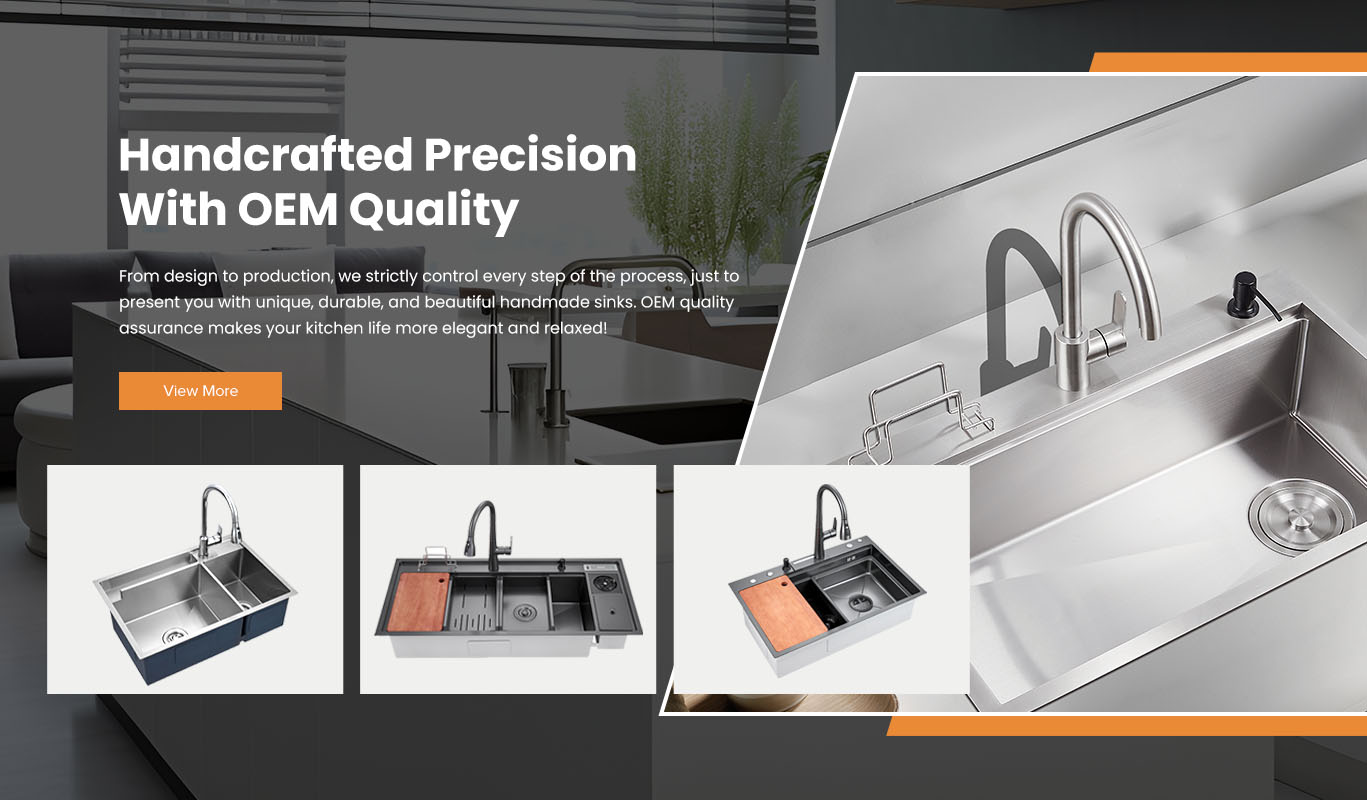
A handmade sink provides greater design flexibility through customized craftsmanship, while a machine pressed sink offers efficient standardized production. The better option depends on customization needs and product positioning.
The main difference between a handmade sink and a machine pressed sink is how the stainless steel material is shaped and processed during manufacturing.
A handmade sink is produced through individual fabrication processes, including cutting, bending, welding, grinding, and finishing. This allows manufacturers to adjust product details according to specific design requirements.
A machine pressed sink is created through automated forming equipment that shapes stainless steel sheets using molds. This process provides high production efficiency and consistent dimensions.
From a manufacturing perspective, design flexibility is closely related to production methods. Custom projects require adaptable manufacturing capabilities, while standard products benefit from efficient and repeatable processes.
A handmade sink provides manufacturers with more freedom to adjust product structures and appearance details.
Key design advantages include:
Flexible sink dimensions
Customized bowl configurations
Adjustable corner designs
More surface finishing options
Because each production stage can be individually controlled, handmade sinks can be adapted for unique kitchen layouts and special project requirements.
This makes them suitable for:
Premium residential kitchens
Customized kitchen projects
Designer interior applications
Brand-specific product development
Manufacturers can modify details such as sink size, bowl depth, radius design, welding structure, and surface treatment to meet different market requirements.
Machine pressed sinks focus on production consistency and standardized design.
Their advantages include:
Stable product dimensions
Consistent appearance
Efficient manufacturing process
Suitable performance for large-volume supply
The mold-based forming process allows manufacturers to reproduce the same sink design repeatedly with reliable accuracy.
Machine pressed sinks are commonly suitable for:
Standard residential kitchens
Large housing projects
Commercial supply programs
Markets requiring consistent products
Although customization is more limited compared with handmade production, pressed sinks provide strong value for standardized applications.
When projects require unique designs, handmade manufacturing usually provides more flexibility.
Handmade sink production allows customization of:
Overall sink dimensions
Number and arrangement of bowls
Drainboard structures
Corner radius
Surface finishing styles
This flexibility is valuable when kitchen layouts, brand requirements, or market preferences differ from standard product specifications.
Machine pressed sinks are more suitable when the design has already been finalized and large quantities of identical products are required.
Machine pressed sinks can support certain levels of customization, but changes usually require additional tooling and mold adjustments.
Customization may involve:
New mold development
Modified dimensions
Updated forming parameters
Additional production preparation
This makes pressed sink customization more suitable for larger-volume projects where the investment in tooling can be justified.
For smaller customized orders, handmade production often provides greater flexibility.
Different kitchen applications have different design requirements.
| Application Type | More Suitable Process | Reason |
|---|---|---|
| Luxury kitchen projects | Handmade Sink | Higher customization and premium appearance |
| Standard housing projects | Machine Pressed Sink | Consistent production and efficiency |
| Custom interior designs | Handmade Sink | Flexible dimensions and details |
| Large-volume supply | Machine Pressed Sink | Stable quality and production speed |
The ideal manufacturing method depends on whether the project values uniqueness or production efficiency.
Design flexibility does not mean reducing quality standards.
Professional sink manufacturers control:
| Quality Factor | Manufacturing Importance |
|---|---|
| Material inspection | Ensures stainless steel reliability |
| Dimension accuracy | Maintains installation compatibility |
| Welding quality | Supports structural durability |
| Surface treatment | Improves appearance and cleaning |
| Final inspection | Ensures consistent performance |
Handmade production requires skilled workmanship, while pressed production requires precise equipment control.
Both methods depend on strict quality management.
OEM requirements often depend on brand positioning and target market.
Handmade sinks are suitable for OEM projects requiring:
Unique product designs
Premium market positioning
Flexible specifications
Brand differentiation
Machine pressed sinks are suitable for OEM projects requiring:
Standard product lines
Large production quantities
Consistent specifications
Efficient manufacturing cycles
Manufacturers with multiple production capabilities can provide more suitable solutions for different business models.
The right choice depends on the importance of customization, production volume, and market positioning.
A handmade sink is recommended when:
Design uniqueness is important
Custom dimensions are required
Premium appearance is needed
Flexible development is preferred
A machine pressed sink is recommended when:
Standard designs are acceptable
Large quantities are needed
Production efficiency is important
Cost optimization is required
Choosing the right manufacturing process helps ensure the sink matches both technical requirements and market expectations.
A handmade sink offers better design flexibility because manufacturers can adjust dimensions, structures, and finishing details according to specific requirements. A machine pressed sink provides better efficiency and consistency for standardized production.
The best choice depends on customization needs, project scale, target market, and expected product positioning.