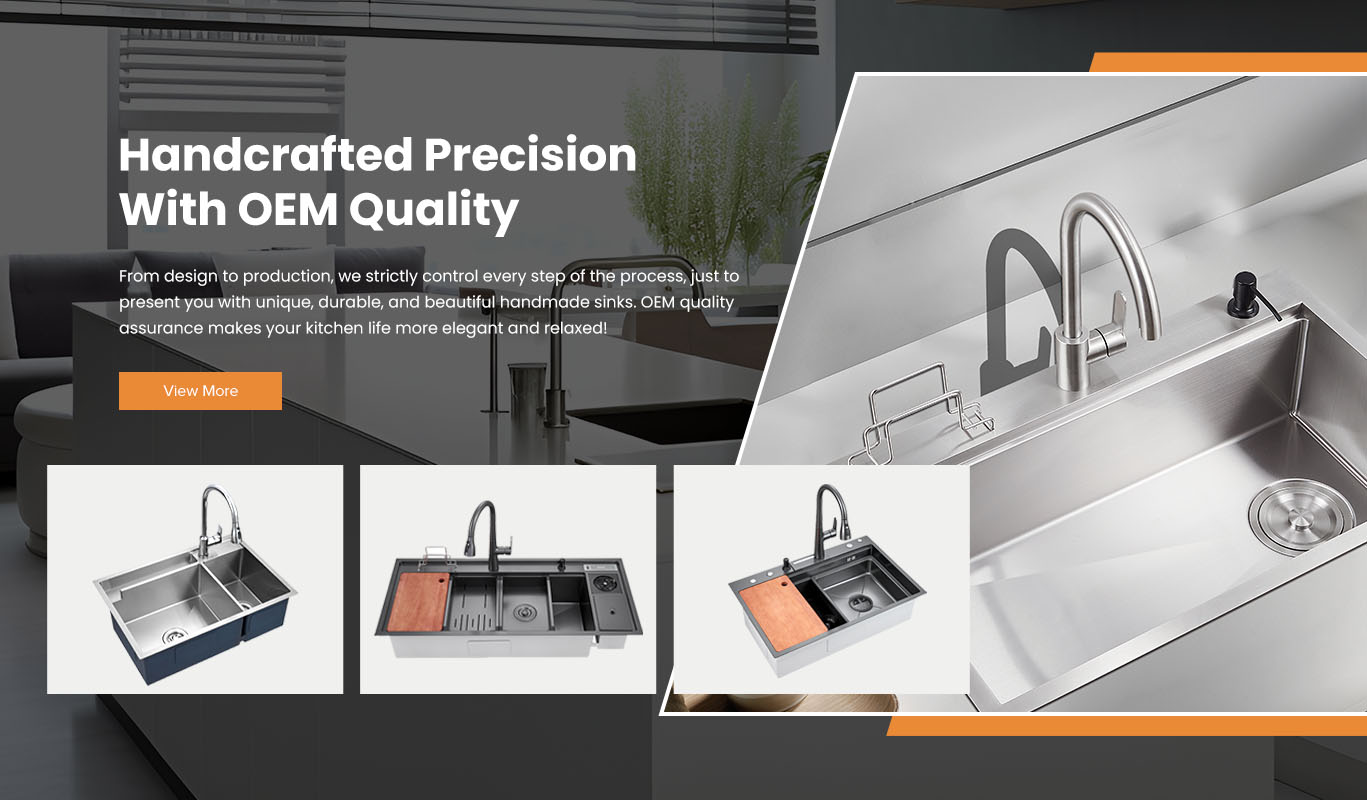
A countertop sink offers flexible installation and replacement options, while an integrated sink provides seamless design and stronger visual consistency. The better choice depends on project goals, materials, and application requirements.
The main difference between a countertop sink and an integrated sink is how the sink connects with the surrounding kitchen surface.
A countertop sink is installed as an independent component on or below the countertop structure. It provides flexibility in product selection, replacement, and installation across different kitchen environments.
An integrated sink is designed as part of the overall countertop system, creating a continuous connection between the sink and working surface. This approach focuses on unified appearance and simplified visual design.
From a manufacturing perspective, sink selection involves more than appearance. Project requirements, installation conditions, material compatibility, maintenance expectations, and production capabilities all influence the final decision.
A countertop sink is widely used because it adapts to different kitchen layouts and project conditions.
Its main advantages include:
Easier installation process
Wider compatibility with countertop materials
Convenient replacement options
More product choices for different applications
Because the sink is manufactured as an independent unit, designers and contractors can select different sizes, shapes, and configurations according to project requirements.
Countertop sinks are commonly suitable for:
Residential kitchen projects
Apartment developments
Renovation applications
Standard kitchen installations
For manufacturers, countertop sink production focuses on dimensional accuracy, surface quality, structural strength, and compatibility with different installation environments.
An integrated sink creates a unified connection between the sink and countertop surface.
Its main benefits include:
Seamless visual appearance
Reduced visible transitions
Better coordination with modern kitchen designs
Easier overall design planning
Because the sink becomes part of the countertop system, integrated designs are often selected for projects where aesthetics and architectural consistency are important.
They are commonly used in:
Premium residential kitchens
Modern interior projects
Luxury housing developments
Customized kitchen solutions
Modern kitchens increasingly focus on clean lines, minimal appearance, and efficient use of space.
Integrated sinks support these trends by providing:
Smooth surface continuity
A customized appearance
Better visual connection between components
Countertop sinks remain popular because they offer practical flexibility and easier adaptation to different project conditions.
The better choice depends on whether the project prioritizes design integration or installation versatility.
Large-scale projects require solutions that balance quality, efficiency, and installation management.
Countertop sinks often provide advantages in large projects because:
Product standardization is easier
Replacement and maintenance are more convenient
Installation processes are more familiar
Different layouts can use the same product series
Integrated sinks may provide stronger design value in premium developments where customized appearance is a major requirement.
Project scale, budget, installation schedule, and design objectives should all be considered.
Material compatibility is an important factor when choosing between countertop and integrated sink designs.
Countertop sinks can work with:
Stone countertops
Quartz surfaces
Laminate materials
Various kitchen structures
Integrated sinks usually require more coordinated material planning because the sink and countertop must function as one system.
Manufacturers evaluate material characteristics, installation methods, and usage conditions to ensure reliable long-term performance.
Different sink designs require different manufacturing approaches.
Important quality factors include:
| Quality Factor | Project Impact |
|---|---|
| Stainless steel grade | Determines durability and corrosion resistance |
| Material thickness | Supports structural stability |
| Surface finishing | Improves appearance and maintenance |
| Dimension accuracy | Ensures installation compatibility |
| Drainage design | Improves daily performance |
Professional sink manufacturers adjust production processes according to product structure and application requirements.
Maintenance performance depends on design, material quality, and installation accuracy.
Countertop sinks usually provide easier replacement and repair because the sink functions as an independent component.
Integrated sinks often provide easier visual maintenance because they reduce visible joints and create smoother surfaces.
Both designs can achieve excellent long-term performance when manufactured with quality stainless steel and proper installation methods.
The right choice depends on project requirements and expected usage.
A countertop sink is recommended when:
Installation flexibility is important
Replacement convenience is required
Different countertop conditions are involved
Standardized solutions are preferred
An integrated sink is recommended when:
Seamless design is a priority
Premium appearance is required
Customized kitchen solutions are needed
Visual consistency matters
For OEM and customized sink projects, manufacturers evaluate application environments, market preferences, and technical requirements before developing suitable solutions.
A countertop sink meets more general project requirements through installation flexibility and compatibility, while an integrated sink provides stronger design integration for premium applications.
The best solution depends on project scale, design goals, material requirements, installation conditions, and long-term maintenance expectations.