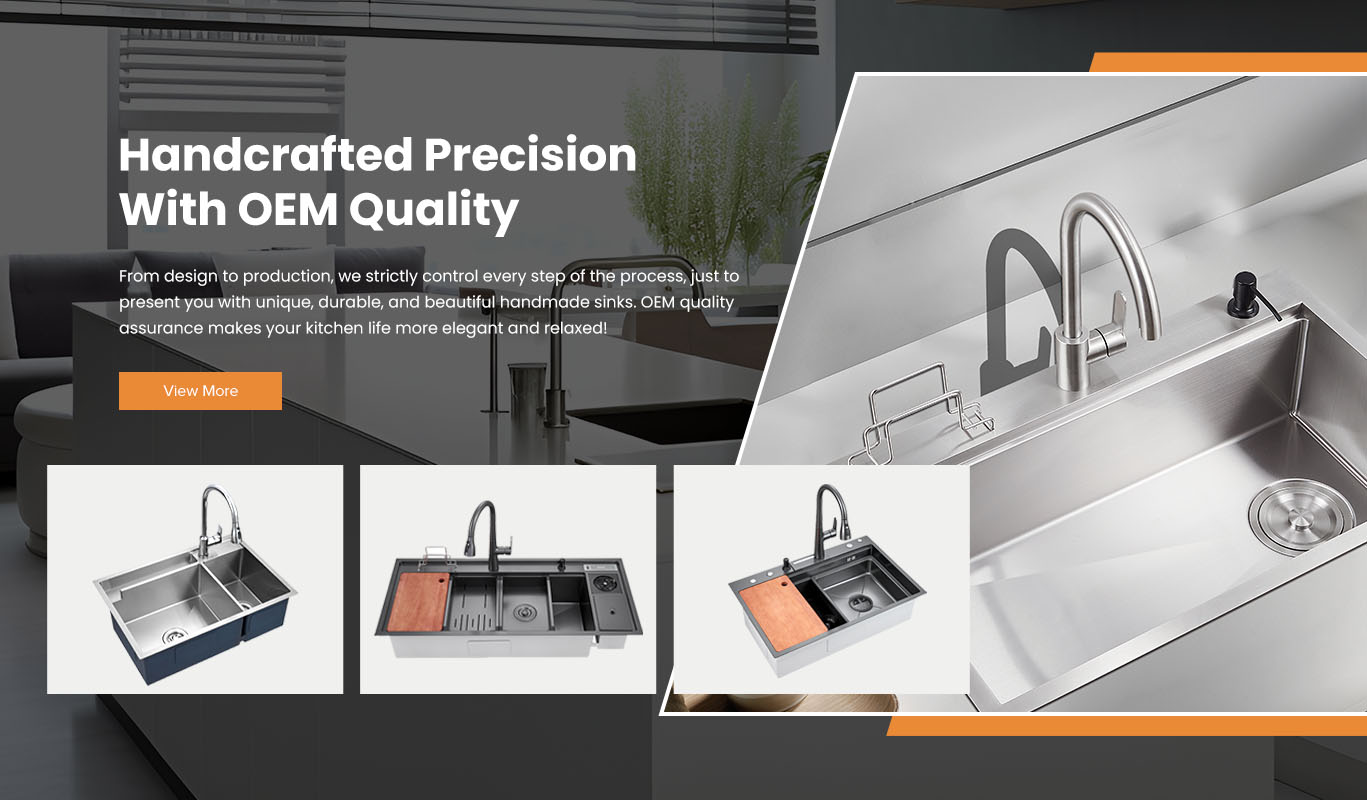
A flush mount sink offers the smoothest countertop transition, while an undermount sink provides easier debris removal. Both improve cleaning performance in different ways depending on kitchen design and usage needs.
The main difference between a flush mount sink and an undermount sink is the position of the sink edge compared with the countertop surface.
A flush mount sink is installed so the sink edge and countertop surface are positioned at the same level. This creates a flat transition area that reduces barriers between the sink and surrounding workspace.
An undermount sink is installed beneath the countertop, leaving the countertop edge visible above the sink opening. This creates a clean connection where water and debris can be pushed directly into the basin.
From a manufacturing perspective, cleaning performance depends on more than installation style. Sink edge design, surface finishing, drainage structure, material quality, and installation accuracy all influence daily maintenance.
A flush mount sink creates a level surface between the countertop and sink, which can simplify daily cleaning tasks.
Key advantages include:
Smooth movement of water and debris into the sink
Reduced areas where food particles can collect
Easier wiping across the countertop area
Improved visual cleanliness
Because there is no significant height difference between the sink and countertop, users can clean the surrounding area with fewer obstacles.
This design is especially suitable for modern kitchens that prioritize hygiene, simple maintenance, and integrated appearance.
For manufacturers, producing flush mount sinks requires precise edge control, accurate dimensions, and consistent surface treatment to achieve proper installation results.
An undermount sink is widely recognized for its practical cleaning benefits.
Its main advantages include:
Allowing food particles to be swept directly into the basin
Eliminating the raised rim above the countertop
Creating a cleaner connection between sink and workspace
Supporting easier countertop maintenance
The hidden installation style reduces interruptions when wiping the countertop surface.
This makes undermount sinks popular in:
Modern residential kitchens
Premium kitchen projects
Stone countertop applications
Custom interior designs
Food residue management is an important factor in kitchen hygiene.
A flush mount sink provides advantages because:
The sink and countertop form a continuous surface
There are fewer height differences around the sink area
Cleaning tools can move smoothly across the workspace
An undermount sink also performs well because:
Food particles can move directly into the basin
The countertop edge remains exposed and easy to wipe
The sink area looks cleaner and more integrated
The difference is mainly related to the transition design between the sink and countertop.
Maintenance requirements depend on installation quality and product design.
Flush mount sinks can reduce cleaning difficulty because the level surface minimizes edges and gaps.
Undermount sinks simplify countertop cleaning because debris can be moved directly into the sink without a raised rim.
Both designs require:
Proper sealing
High-quality stainless steel
Effective drainage
Accurate installation
Poor installation can affect maintenance performance regardless of sink type.
Long-term hygiene depends on how easily users can keep the sink area clean.
Flush mount sinks support hygiene through:
Reduced surface interruptions
Easier water management
Integrated workspace design
Undermount sinks support hygiene through:
Easy countertop wiping
Reduced exposed sink edges
Cleaner visual structure
For professional kitchens and premium residential applications, manufacturers often focus on seamless designs because they reduce unnecessary cleaning steps.
Installation method is only one part of cleaning performance. Material and manufacturing quality are equally important.
Important factors include:
| Quality Factor | Cleaning Impact |
|---|---|
| Stainless steel grade | Improves corrosion resistance |
| Surface finish | Reduces stain attachment |
| Edge precision | Prevents dirt accumulation areas |
| Drainage design | Helps remove water efficiently |
| Welding quality | Maintains smooth internal structure |
A high-quality sink with accurate manufacturing can provide better cleaning performance regardless of installation style.
Modern kitchens often require both visual quality and practical maintenance.
Flush mount sinks are commonly suitable for:
Minimalist kitchen designs
Integrated countertop systems
Premium residential projects
Contemporary interiors
Undermount sinks are commonly suitable for:
Luxury kitchens
Stone countertop applications
High-end renovation projects
Designs requiring seamless appearance
Manufacturers provide different installation solutions because kitchen environments and market preferences vary.
Professional sink manufacturers evaluate multiple factors during product development.
Important considerations include:
| Design Consideration | Performance Influence |
|---|---|
| Sink edge structure | Determines cleaning convenience |
| Bowl design | Affects washing efficiency |
| Surface treatment | Improves maintenance |
| Drainage system | Controls water flow |
| Installation compatibility | Ensures stable performance |
Product development focuses on balancing appearance, durability, and practical daily use.
The right choice depends on cleaning expectations and kitchen requirements.
A flush mount sink is recommended when:
A completely level surface is preferred
Easy countertop movement is important
Integrated design is required
Modern appearance is a priority
An undermount sink is recommended when:
Countertop cleaning convenience is important
Premium design is required
Debris removal efficiency matters
Seamless visual integration is preferred
For OEM and customized sink projects, manufacturers evaluate application environments, countertop materials, and user requirements before selecting the best structure.
A flush mount sink provides excellent cleaning performance through its level countertop transition, while an undermount sink offers strong advantages for countertop maintenance and debris removal.
The better choice depends on kitchen design, cleaning habits, installation conditions, and the expected user experience.