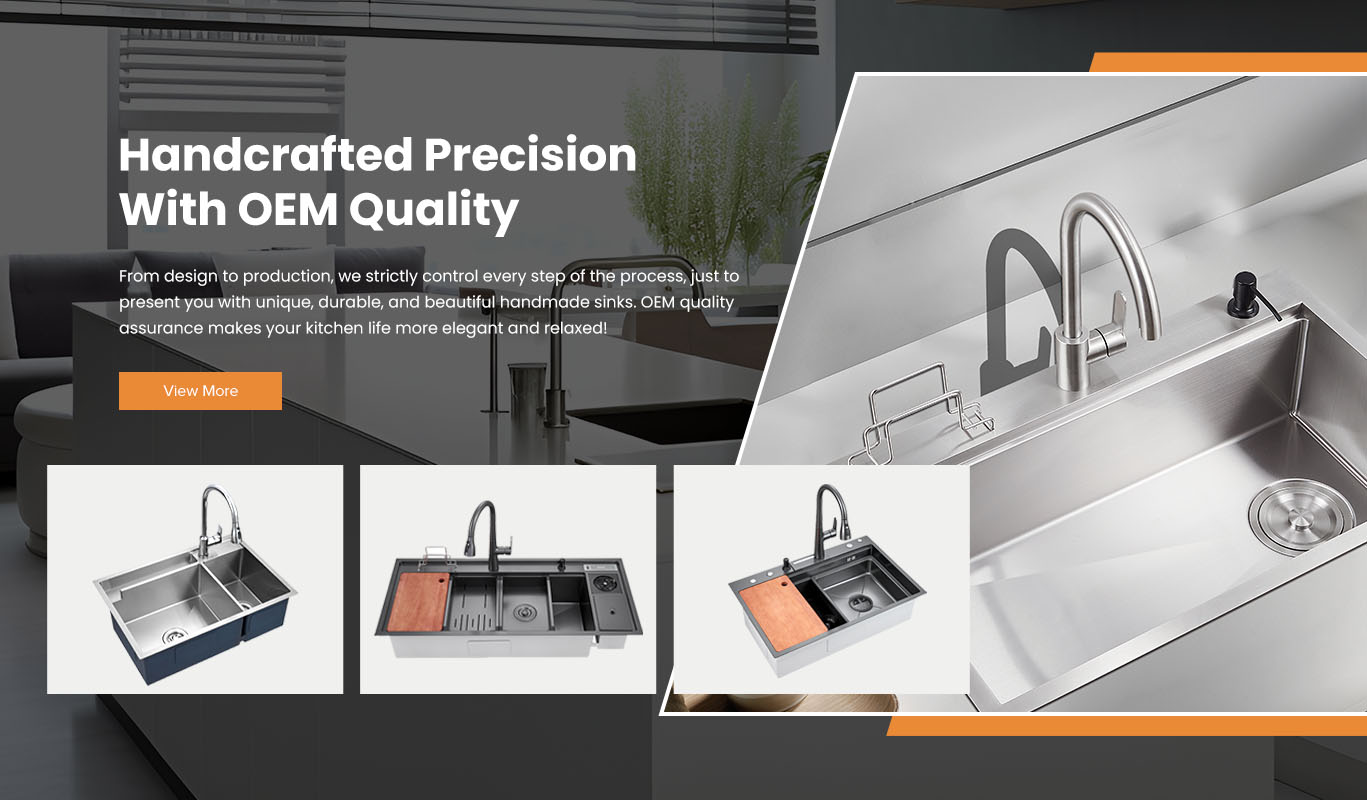
A flush mount sink offers easier countertop cleaning with a seamless surface, while a topmount kitchen sink provides simpler installation and replacement. The better choice depends on maintenance needs and project requirements.
The main difference between a topmount kitchen sink and a flush mount sink is the relationship between the sink edge and the countertop surface.
A topmount kitchen sink is installed from above the countertop, with the sink rim visible and resting on the countertop surface. This structure provides strong support and makes installation more flexible.
A flush mount sink is installed so that the sink edge aligns evenly with the countertop surface. The transition between the sink and countertop is smoother, creating a more integrated appearance.
From a manufacturing perspective, installation style affects not only appearance but also cleaning convenience, edge design, installation accuracy, and long-term maintenance requirements.
A flush mount sink creates a level transition between the sink and countertop, reducing barriers around the washing area.
Key maintenance advantages include:
Easier removal of food particles and water from the countertop
Fewer raised edges where dirt can collect
Smoother visual and functional integration
More convenient daily cleaning
Because the countertop and sink surface are aligned, users can wipe debris directly into the basin without encountering a raised rim.
This design is especially suitable for modern kitchens that prioritize hygiene, simple maintenance, and clean visual appearance.
For manufacturers, producing flush mount sinks requires precise edge control, accurate dimensions, and consistent surface finishing to achieve proper alignment during installation.
A topmount kitchen sink remains popular because of its practical structure and installation flexibility.
Its advantages include:
Easier installation process
Wider compatibility with different countertops
Convenient replacement and maintenance access
Strong support from the countertop surface
The visible sink rim helps protect the countertop opening and provides additional structural support.
For many residential projects, topmount sinks offer reliable performance with simpler maintenance procedures, especially when installed correctly with high-quality sealing.
The sink edge design directly affects cleaning convenience.
A flush mount sink usually has fewer visible transitions between the countertop and sink, reducing areas where food residue and water deposits may accumulate.
A topmount kitchen sink has a raised edge around the basin. Although this edge provides installation advantages, it requires regular cleaning around the rim area.
However, maintenance performance also depends on:
Surface smoothness
Stainless steel quality
Sealing quality
Drainage design
Installation accuracy
A well-manufactured topmount sink can still provide excellent hygiene performance.
Busy kitchens require fast cleaning and efficient workflow.
Flush mount sinks can improve efficiency because:
Countertops are easier to wipe
Water movement is easier to control
Cleaning tasks require fewer steps
They are often preferred in kitchens where appearance and daily maintenance are equally important.
Topmount kitchen sinks remain practical for environments where easy installation, replacement flexibility, and durability are higher priorities.
The better option depends on whether the project values cleaning convenience or installation simplicity.
Replacement convenience is one of the strongest advantages of topmount sinks.
Because the sink is installed above the countertop:
Removal is generally simpler
Installation adjustments are easier
Replacement costs can be lower
Compatibility with existing countertops is broader
Flush mount sinks usually require more precise countertop preparation. Replacement may involve additional adjustment to maintain the level transition.
For renovation projects, topmount sinks often provide greater flexibility.
Maintenance performance depends heavily on manufacturing quality, regardless of installation style.
Important quality factors include:
| Manufacturing Factor | Maintenance Impact |
|---|---|
| Stainless steel grade | Improves corrosion resistance |
| Surface treatment | Reduces stains and improves cleaning |
| Edge accuracy | Ensures proper installation fit |
| Welding quality | Prevents structural issues |
| Drainage design | Helps avoid standing water |
Professional sink manufacturers focus on precision production to ensure both topmount and flush mount designs deliver stable performance.
modern kitchen trends often emphasize simple lines, easy cleaning, and integrated appearance.
Flush mount sinks are commonly selected for:
Minimalist kitchens
Premium residential projects
Contemporary interior designs
High-end renovation applications
Topmount kitchen sinks are commonly selected for:
Standard residential kitchens
Large housing projects
Renovation projects
Applications requiring flexible installation
Both styles can meet modern kitchen requirements when matched with the right design and manufacturing quality.
The right choice depends on maintenance expectations, installation conditions, and design goals.
A flush mount sink is recommended when:
Easy countertop cleaning is important
Seamless appearance is preferred
Modern design is required
Professional installation is available
A topmount kitchen sink is recommended when:
Installation flexibility is needed
Replacement convenience matters
Various countertop materials are involved
Practical maintenance is the priority
For OEM and customized sink projects, manufacturers evaluate market preferences, installation requirements, and application environments before recommending suitable sink structures.
A flush mount sink is generally easier to maintain because its level surface reduces cleaning obstacles and creates better countertop integration. A topmount kitchen sink offers easier installation, replacement flexibility, and broad application compatibility.
The best installation style depends on project requirements, kitchen design goals, countertop conditions, and long-term maintenance expectations.