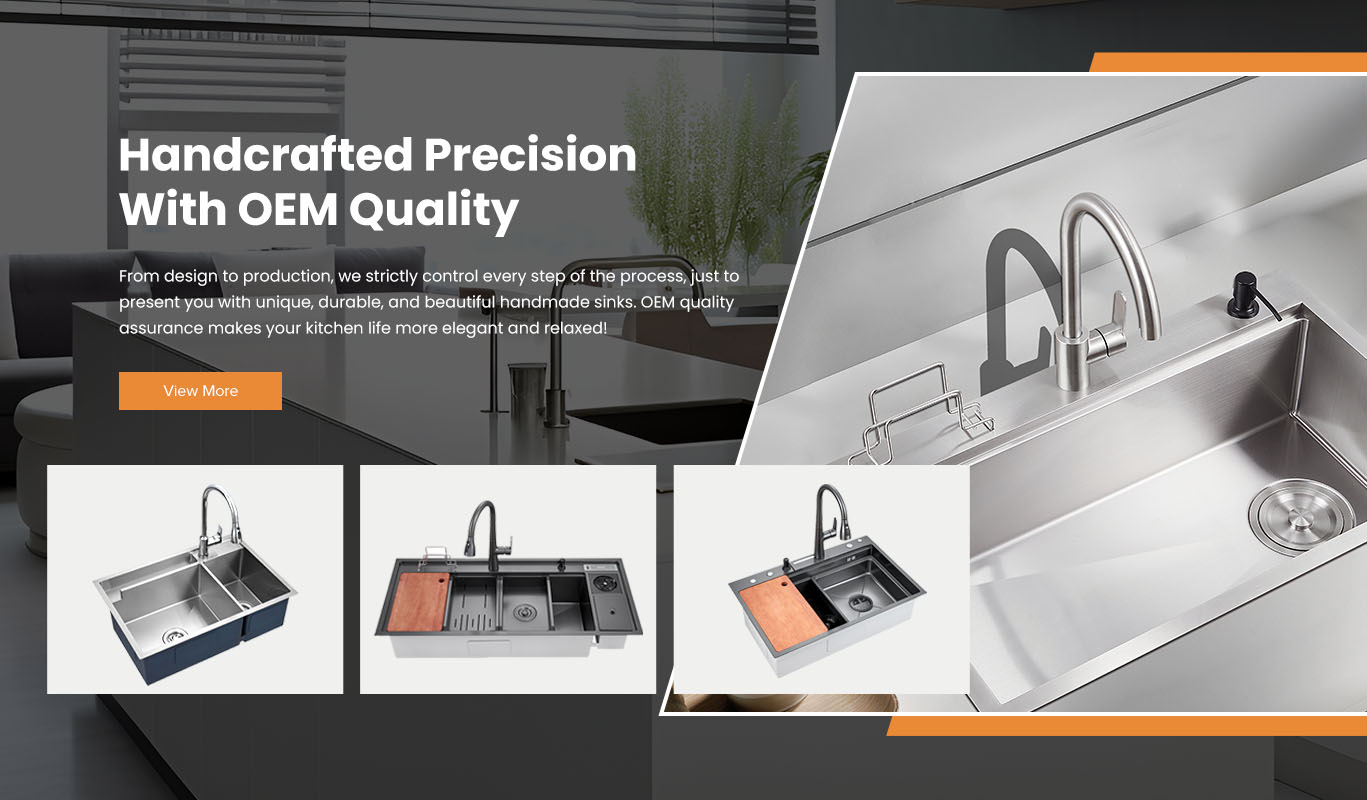
A deep draw sink provides strong reliability through seamless forming and consistent structure, while a fabricated sink offers greater design flexibility through customized manufacturing. The better choice depends on application requirements and production goals.
The main difference between a deep draw sink and a fabricated sink is the production method used to create the sink structure.
A deep draw sink is manufactured by forming a stainless steel sheet into a deep basin shape through pressing technology. The process creates a seamless structure with consistent dimensions and fewer joints.
A fabricated sink is produced by cutting, bending, welding, and assembling multiple stainless steel components. This method allows manufacturers to create customized designs and complex structures.
From a manufacturer’s perspective, reliability depends on more than production method. Material quality, manufacturing precision, welding control, and inspection standards all influence long-term performance.
A deep draw sink gains reliability from its integrated forming structure.
Key advantages include:
Seamless basin construction
Reduced connection points
Consistent product dimensions
Stable structural performance
Because the sink body is formed from a single piece of stainless steel, there are fewer areas that require joining.
This makes deep draw sinks suitable for:
Standard residential kitchens
Large-volume production
Commercial supply programs
Applications requiring consistent quality
The controlled forming process helps manufacturers maintain stable performance across large production quantities.
A fabricated sink creates reliability through flexible structural design and controlled assembly processes.
Its main advantages include:
Customizable structures
Flexible dimensions
Adaptable product designs
Support for special applications
Fabricated sinks are suitable for:
Customized kitchen projects
Large commercial sinks
Premium product designs
Special installation requirements
When manufactured with precise welding and quality control, fabricated sinks can achieve excellent durability and long-term performance.
Structural strength depends on how the sink is designed and manufactured.
Deep draw sinks provide advantages through:
Continuous material structure
Uniform forming
Reduced welding requirements
Fabricated sinks provide advantages through:
Reinforced welded structures
Flexible material thickness selection
Custom structural improvements
Neither production method automatically guarantees better reliability. Manufacturing accuracy and quality management are critical factors.
The deep drawing process creates a continuous stainless steel structure.
This provides benefits such as:
Reduced risk of joint failure
Consistent basin shape
Stable long-term performance
Easier quality control
For high-volume production, the ability to maintain the same structure across thousands of units is a major advantage.
Fabricated sinks provide reliability through design flexibility.
Manufacturers can adjust:
Sink dimensions
Bowl configurations
Drainboard structures
Material thickness
Reinforcement areas
This makes fabricated sinks valuable for applications where standard sizes cannot meet specific requirements.
Customization allows manufacturers to optimize the sink structure according to actual usage conditions.
Heavy-use applications require strong materials and reliable construction.
Deep draw sinks perform well in:
Standard commercial applications
High-volume environments
Projects requiring consistent performance
Fabricated sinks perform well in:
Heavy-duty custom applications
Industrial kitchens
Special project requirements
The better choice depends on whether the priority is standardized durability or customized strength.
Different production methods require different quality control approaches.
| Production Method | Main Quality Control Focus |
|---|---|
| Deep Draw Sink | Forming accuracy, material consistency, surface quality |
| Fabricated Sink | Welding quality, assembly precision, structural inspection |
Professional manufacturers apply strict inspection procedures to ensure reliable performance regardless of production method.
OEM requirements vary depending on product strategy.
Deep draw sinks are suitable for OEM projects requiring:
Standardized product lines
Large production quantities
Stable quality
Efficient manufacturing
Fabricated sinks are suitable for OEM projects requiring:
Custom designs
Unique specifications
Premium product positioning
Flexible development
Manufacturers with both production capabilities can support different market requirements.
Long-term reliability depends on multiple production factors.
Important factors include:
| Quality Factor | Reliability Impact |
|---|---|
| Stainless steel grade | Determines corrosion resistance |
| Material thickness | Supports structural strength |
| Forming accuracy | Maintains product stability |
| Welding quality | Ensures joint reliability |
| Final inspection | Confirms performance |
A professional manufacturing system combines production technology with quality control to deliver reliable sink solutions.
Not necessarily.
A deep draw sink provides strong reliability through seamless construction, but it may have limitations in customization.
A fabricated sink can provide excellent reliability when:
Welding quality is controlled
Materials are properly selected
Structure is professionally designed
The correct choice depends on the application rather than production method alone.
The right choice depends on project requirements, product volume, and design expectations.
A deep draw sink is recommended when:
Consistent quality is required
Large production volume is needed
Standard designs are preferred
Efficient manufacturing is important
A fabricated sink is recommended when:
Custom dimensions are required
Unique designs are needed
Special applications are involved
Product differentiation matters
Selecting the appropriate production method helps achieve the right balance between reliability, flexibility, and cost efficiency.
A deep draw sink provides reliable performance through seamless forming, consistent structure, and stable production quality. A fabricated sink provides reliable performance through flexible design, customized structures, and controlled manufacturing processes.
The best production method depends on application requirements, product strategy, manufacturing quality, and expected performance standards.