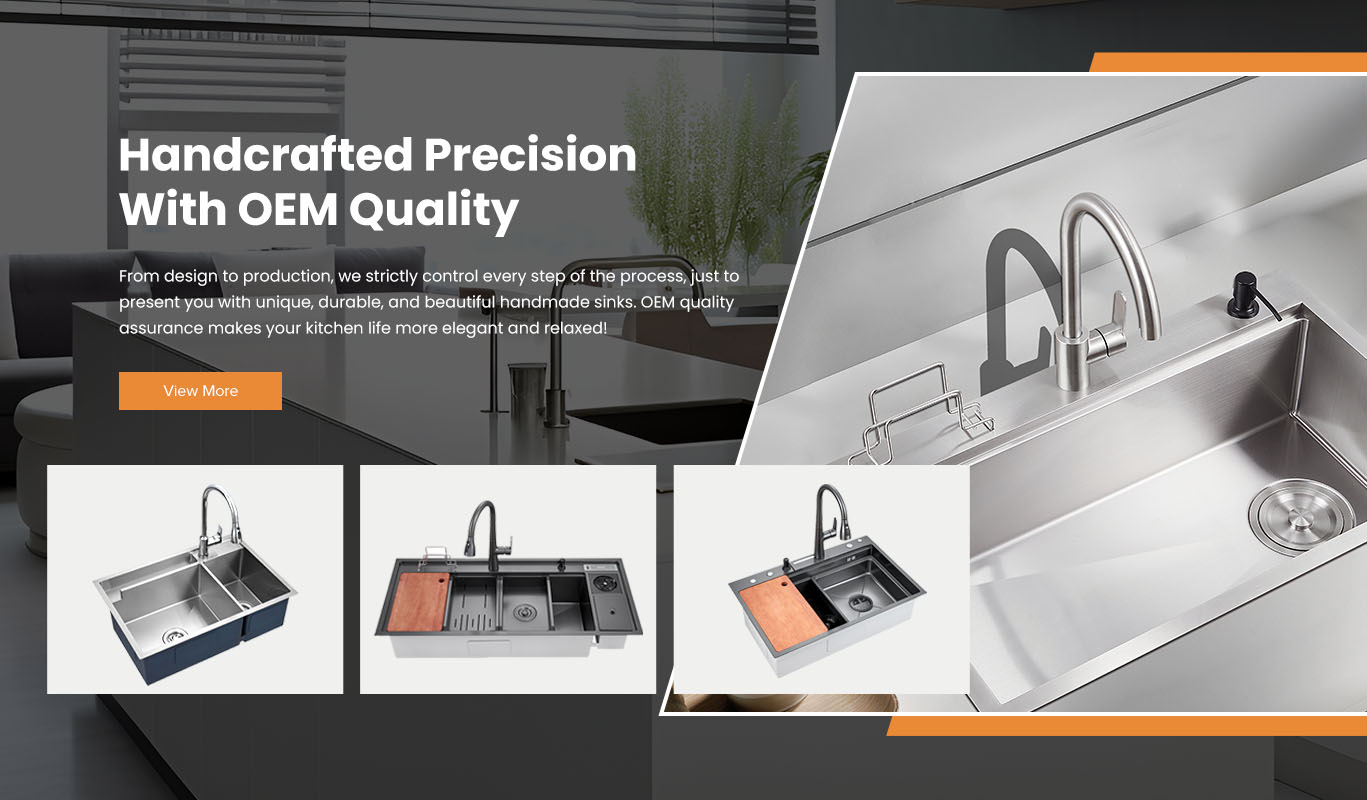
A small batch handmade sink supports flexible product development and market differentiation, while a large volume pressed sink supports efficiency and scalability. The better strategy depends on brand goals, market stage, and sales objectives.
The main difference between a small batch handmade sink and a large volume pressed sink is the production approach and the business strategy each model supports.
A small batch handmade sink is produced through flexible manufacturing processes, including cutting, forming, welding, polishing, and detailed inspection. This method allows manufacturers to adjust designs and produce limited quantities with greater customization.
A large volume pressed sink is manufactured through mold-based forming and automated production processes. This approach focuses on efficiency, consistent quality, and high-volume output.
From a manufacturer’s perspective, production volume is not only a manufacturing decision. It directly affects product positioning, market response, investment requirements, and long-term business strategy.
A small batch handmade sink provides brands with more flexibility during product development.
Key advantages include:
Lower commitment for new product testing
Faster design adjustments
Easier customization
Better support for niche markets
Small batch production allows brands to test:
New designs
Different market preferences
Premium product concepts
Regional kitchen requirements
This makes handmade sinks suitable for:
Emerging kitchen brands
Boutique product collections
Custom projects
Premium market segments
Manufacturers can refine product details based on market feedback before moving toward larger production.
Large volume pressed sinks support brands that require stable supply and efficient scaling.
Their main advantages include:
Higher production capacity
Stable product consistency
Lower unit cost at scale
Reliable supply for expanding markets
The standardized pressing process allows manufacturers to produce large quantities with predictable specifications.
Large volume pressed sinks are commonly suitable for:
Established product lines
Retail distribution
Large construction projects
High-demand markets
For brands with proven products and strong sales channels, large-scale production provides operational advantages.
New product development often requires flexibility before committing to large investments.
Small batch handmade sinks provide advantages because:
Product concepts can be tested quickly
Design changes are easier to implement
Market feedback can guide improvements
Initial inventory pressure is reduced
This approach is valuable when brands are developing new collections or entering unfamiliar markets.
Large volume pressed sinks are more suitable after product demand has been validated and stable production is required.
Production volume influences how a product is positioned in the market.
| Product Strategy | Recommended Production Model | Main Advantage |
|---|---|---|
| Premium collection | Small Batch Handmade Sink | Greater uniqueness |
| Market testing | Small Batch Handmade Sink | Flexible development |
| Mass distribution | Large Volume Pressed Sink | Efficient supply |
| Established products | Large Volume Pressed Sink | Stable production |
The right production model should match the brand’s growth stage and market objectives.
Premium markets often focus on uniqueness, craftsmanship, and product experience.
Small batch handmade sinks provide advantages through:
Customized appearance
Detailed craftsmanship
Limited product positioning
Stronger brand storytelling
These features help brands create products that stand apart from standard market offerings.
For premium kitchen brands, the manufacturing process itself can become part of the product value.
Large volume pressed sinks are ideal when efficiency and scalability are priorities.
They are suitable when:
Demand is predictable
Large quantities are required
Product specifications are stable
Cost efficiency is important
The standardized process helps manufacturers maintain consistent quality while meeting higher production requirements.
This makes pressed sinks suitable for businesses focused on market expansion and supply reliability.
Quality management is essential for both small batch and large volume production.
Important factors include:
| Quality Control Factor | Manufacturing Impact |
|---|---|
| Stainless steel inspection | Ensures material reliability |
| Dimension control | Maintains product accuracy |
| Welding quality | Supports durability |
| Surface inspection | Controls appearance |
| Final testing | Confirms performance |
Small batch production relies more on craftsmanship and detailed inspection.
Large volume production relies more on process control and equipment precision.
OEM requirements depend on the brand’s development strategy.
Small batch handmade sinks are suitable for OEM projects requiring:
Customized designs
Product testing
Unique market positioning
Flexible development
Large volume pressed sinks are suitable for OEM projects requiring:
Stable product models
Large quantities
Cost optimization
Long-term supply
A manufacturer with both capabilities can support brands at different development stages.
Yes. Many brands use different production models at different stages.
A common development approach includes:
Using small batch handmade sinks for concept testing and market validation.
Adjusting product designs based on customer feedback.
Moving successful products into larger-scale production.
This approach helps brands reduce development risk while maintaining opportunities for growth.
The right choice depends on product strategy and business objectives.
A small batch handmade sink is recommended when:
New product testing is needed
Customization is important
Premium positioning is targeted
Market flexibility is required
A large volume pressed sink is recommended when:
Demand is established
Large supply capacity is needed
Cost efficiency is important
Product specifications are fixed
Selecting the appropriate production model helps brands balance innovation, investment, efficiency, and market growth.
A small batch handmade sink better supports flexible product strategies through customization, testing, and differentiation. A large volume pressed sink better supports scaling strategies through efficiency, consistency, and reliable supply.
The best choice depends on brand stage, market demand, product positioning, and long-term development goals.