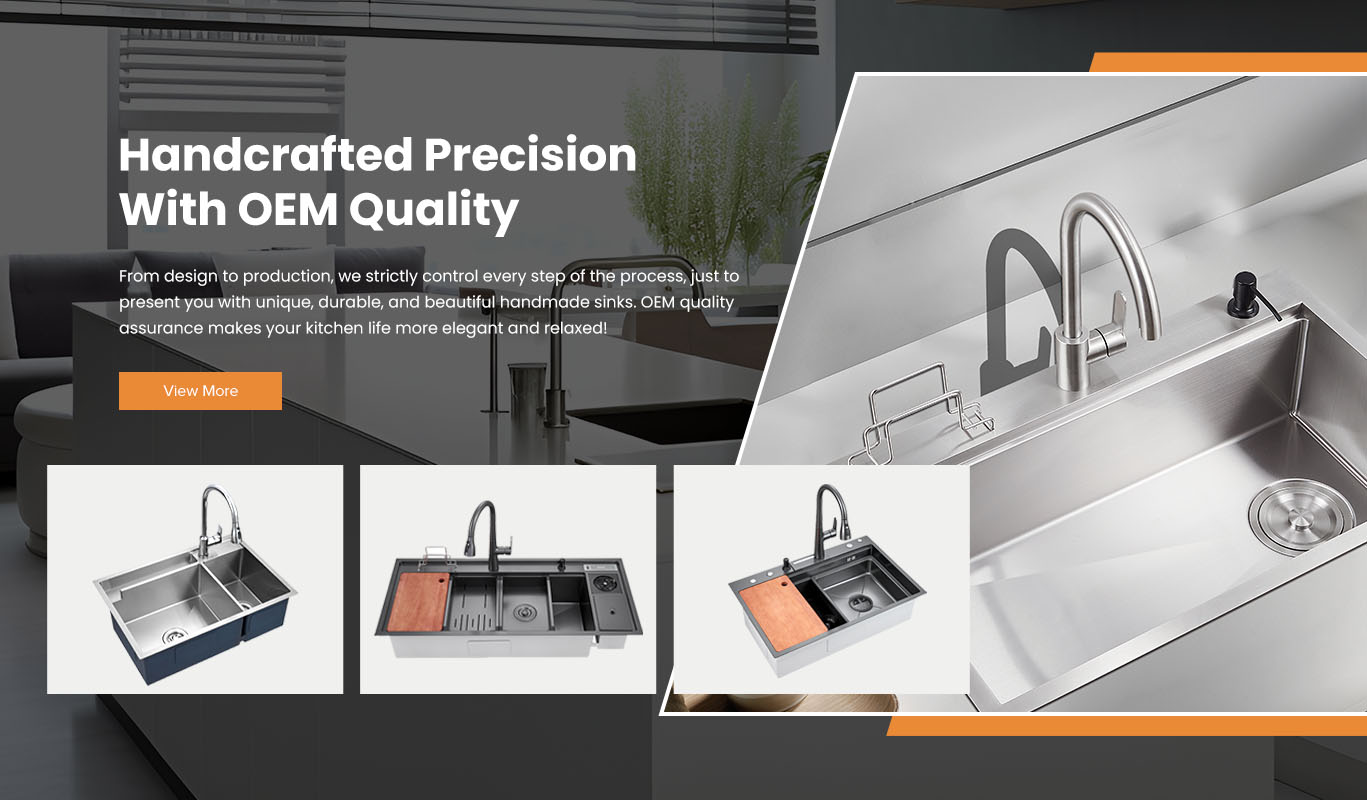
A handcrafted sink provides greater customization flexibility for brand differentiation, while a mass production sink offers efficiency and consistent supply. The better choice depends on brand strategy, market positioning, and production goals.
The main difference between a handcrafted sink and a mass production sink is the manufacturing approach and level of customization available.
A handcrafted sink is produced through detailed fabrication processes, including cutting, forming, welding, polishing, and finishing. This method allows manufacturers to adjust product details according to specific brand requirements.
A mass production sink is manufactured through standardized processes and automated equipment. It focuses on production efficiency, consistent quality, and large-volume supply.
From a brand development perspective, the choice between these two production methods depends on whether a company needs unique product identity or efficient product distribution.
A handcrafted sink provides brands with greater flexibility when developing differentiated products.
Key customization advantages include:
Flexible product dimensions
Unique bowl configurations
Customized design details
More options for surface finishes
Manufacturers can adjust various elements, including:
Sink size
Bowl structure
Corner design
Edge details
Installation style
Surface treatment
This flexibility helps brands create products that better match their target customers and market positioning.
Handcrafted sinks are often suitable for:
Premium kitchen brands
Luxury residential projects
Customized interior solutions
Boutique product lines
Mass production sinks create value through efficiency, consistency, and supply reliability.
Their main advantages include:
Stable product specifications
Consistent appearance across batches
Faster production capacity
Better cost control
For brands serving larger markets, standardized products can simplify inventory management and improve supply chain efficiency.
Mass production sinks are commonly suitable for:
Large retail programs
Standard kitchen product lines
High-volume distribution
Projects requiring consistent supply
Brand differentiation depends on how unique the product needs to be.
Handcrafted sinks provide stronger differentiation because brands can develop:
Exclusive designs
Special dimensions
Premium product features
Market-specific solutions
This helps brands create a stronger identity beyond price competition.
Mass production sinks create differentiation through:
Product selection
Packaging design
Brand positioning
Distribution strategy
They are more suitable for brands that focus on efficient market coverage rather than exclusive product development.
OEM brands often need products that reflect their market positioning.
Handcrafted sinks provide advantages for OEM development because manufacturers can support:
Prototype creation
Design modifications
Small-batch production
Special product requirements
This is especially valuable when brands are testing new markets or developing premium product categories.
Mass production sinks are more effective when the product design has already been finalized and large-scale production is required.
New product development requires flexibility during design adjustment and testing.
Handcrafted sink production supports new launches through:
Faster design changes
Easier prototype development
Flexible production adjustments
Lower dependence on tooling
Mass production sink development may require:
Mold preparation
Tooling investment
Production setup time
This makes handcrafted production more suitable during early development stages, while mass production becomes more advantageous after market validation.
Different manufacturing methods support different brand strategies.
| Brand Strategy | Suitable Manufacturing Method | Reason |
|---|---|---|
| Premium positioning | Handcrafted Sink | Supports uniqueness and customization |
| Large market coverage | Mass Production Sink | Provides efficient supply |
| Custom collections | Handcrafted Sink | Allows design flexibility |
| Standard product lines | Mass Production Sink | Ensures consistency |
The manufacturing approach should match the brand's long-term market objectives.
Customization requires strong production control to maintain quality.
Important quality factors include:
| Quality Factor | Brand Impact |
|---|---|
| Stainless steel quality | Ensures durability and product value |
| Craftsmanship control | Maintains customized details |
| Dimension accuracy | Supports installation compatibility |
| Surface finishing | Improves premium appearance |
| Final inspection | Ensures consistent delivery |
Professional manufacturers combine skilled production capabilities with strict quality management to support different brand requirements.
Premium brands usually require products that communicate quality and uniqueness.
Handcrafted sinks provide advantages through:
Higher perceived value
Greater design freedom
Custom product development
Stronger brand storytelling
Mass production sinks can also support premium brands when the product strategy focuses on standardized collections and reliable availability.
The right choice depends on how the brand wants customers to perceive the product.
The correct choice depends on business goals and product strategy.
A handcrafted sink is recommended when:
Product differentiation is important
Premium positioning is required
Custom designs are needed
Brand identity depends on unique products
A mass production sink is recommended when:
Large quantities are required
Standard designs are preferred
Supply stability is important
Market expansion is the main goal
Choosing the right manufacturing method helps brands balance customization, quality, production efficiency, and market competitiveness.
A handcrafted sink better supports brand customization because it provides greater design flexibility, product differentiation, and premium positioning opportunities. A mass production sink provides stronger advantages in efficiency, consistency, and large-scale supply.
The best choice depends on brand strategy, target market, production requirements, and long-term development goals.