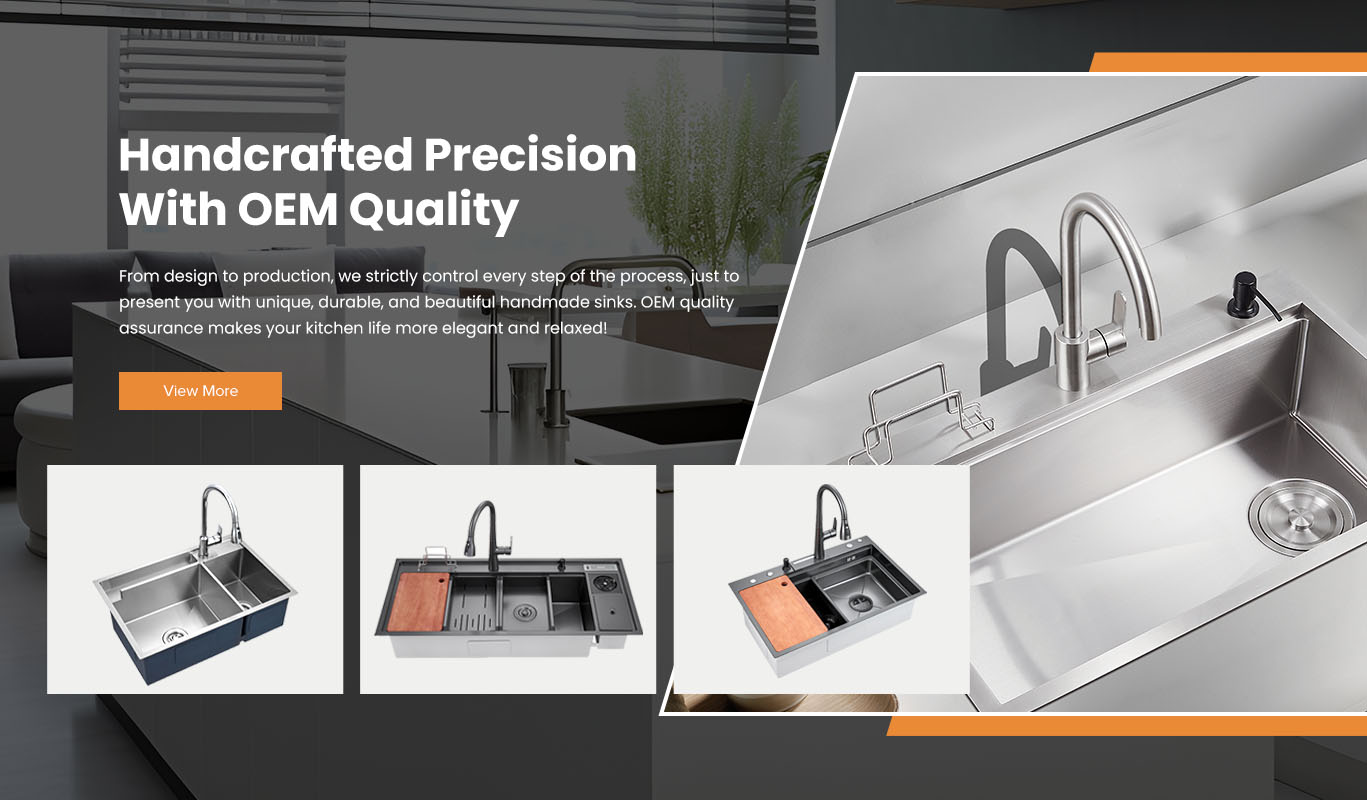
A commercial undermount sink provides better workflow integration and modern cleaning convenience, while a topmount sink offers easier installation and strong support. The better choice depends on usage intensity and kitchen requirements.
The main difference between a commercial undermount sink and a topmount sink is the installation method and how the sink connects with the surrounding countertop or work surface.
A commercial undermount sink is installed beneath the countertop, creating a smooth transition between the sink edge and the working surface. This design allows food debris and water to be moved directly into the basin during cleaning.
A topmount sink is installed from above the countertop, with the sink rim resting on the surface. This structure provides strong support and simpler installation, making it widely used in many commercial environments.
From a manufacturing perspective, heavy-use sink selection involves more than installation style. Durability depends on stainless steel quality, material thickness, structural design, installation conditions, and daily operating requirements.
Commercial undermount sinks are often selected for professional kitchens that prioritize workflow efficiency and easy cleaning.
Key advantages include:
Seamless connection with preparation surfaces
Easier removal of food particles and water
Improved hygiene around the working area
Better integration with modern commercial kitchen designs
In busy kitchens, smooth transitions between work surfaces and sinks can reduce cleaning time and improve overall workflow.
Restaurants, hotels, catering facilities, and premium food service operations often consider undermount designs when cleanliness, appearance, and efficient maintenance are important.
For manufacturers, producing commercial undermount sinks requires precise dimensional control, strong mounting structures, reinforced edges, and reliable welding processes to ensure long-term performance.
Topmount sinks remain a popular choice for commercial environments because of their installation advantages and structural support.
Their main benefits include:
Easier installation and replacement
Compatibility with various countertop materials
Strong support from the surrounding surface
Lower installation complexity
The visible sink rim helps distribute the product weight, which can be beneficial in heavy-use environments.
Topmount sinks are commonly used in commercial kitchens where operational efficiency, easy replacement, and practical installation are key priorities.
Heavy-use commercial kitchens require sinks that can support continuous washing cycles.
A commercial undermount sink provides advantages during frequent cleaning because:
Countertops can be wiped directly into the sink
Fewer raised edges collect debris
Cleaning workflows become more streamlined
A topmount sink also performs well when properly installed, especially in environments where durability and easy maintenance access are more important than seamless appearance.
The better solution depends on whether the kitchen prioritizes cleaning efficiency or installation flexibility.
Durability is influenced by manufacturing quality and installation accuracy rather than installation style alone.
Both commercial undermount sinks and topmount sinks can provide excellent long-term performance when they are manufactured with:
High-quality stainless steel materials
Appropriate material thickness
Strong welding structures
Proper drainage systems
Accurate installation methods
An undermount sink requires stronger support systems because the sink weight is carried from below.
A topmount sink benefits from countertop support around the rim, making installation relatively straightforward.
Different commercial applications have different priorities.
Commercial undermount sinks are often suitable for:
Premium restaurants
Hotel kitchens
Modern food preparation areas
Projects requiring seamless workstations
Topmount sinks are commonly suitable for:
High-volume commercial kitchens
Standard restaurant installations
Renovation projects
Applications requiring flexible replacement
The correct selection depends on kitchen layout, cleaning processes, equipment usage, and maintenance expectations.
Sink installation influences how staff move between preparation, cleaning, and storage areas.
| Consideration | Commercial Undermount Sink | Topmount Sink |
|---|---|---|
| Cleaning workflow | Smooth surface transition | Practical and reliable |
| Installation flexibility | Requires accurate fitting | Easier installation |
| Countertop integration | Excellent | Traditional appearance |
| Heavy-use suitability | High with proper support | High with proper installation |
A well-designed commercial kitchen should select the sink style based on workflow requirements rather than appearance alone.
Professional sink manufacturers focus on multiple production factors to ensure reliability in heavy-use environments.
Important quality factors include:
| Manufacturing Factor | Performance Impact |
|---|---|
| Stainless steel grade | Improves corrosion resistance |
| Material thickness | Supports heavy-duty usage |
| Welding quality | Maintains structural strength |
| Surface treatment | Improves cleaning and appearance |
| Drainage design | Prevents water accumulation |
For commercial applications, manufacturing precision directly affects service life, maintenance frequency, and user experience.
Maintenance requirements vary depending on kitchen operations.
A commercial undermount sink usually provides easier daily surface cleaning because the countertop transition is smoother.
A topmount sink may require additional attention around the visible rim area, where food particles or moisture can accumulate.
However, topmount sinks offer easier access for replacement and repair, which can be valuable in high-frequency commercial environments.
The right choice depends on the working environment and project goals.
A commercial undermount sink is recommended when:
Hygiene and cleaning efficiency are priorities
Modern workstation integration is required
Premium kitchen appearance matters
Professional installation is available
A topmount sink is recommended when:
Installation flexibility is important
Replacement convenience is required
Heavy-duty practicality is the main concern
Various countertop conditions are involved
For OEM and customized commercial sink projects, manufacturers evaluate application environments, workflow requirements, and installation conditions before recommending the suitable structure.
A commercial undermount sink works better for heavy-use kitchens that prioritize seamless workflow, easy cleaning, and modern integration. A topmount sink provides better installation flexibility and practical durability for demanding commercial environments.
The best choice depends on kitchen workflow, maintenance expectations, installation conditions, and long-term operational requirements.