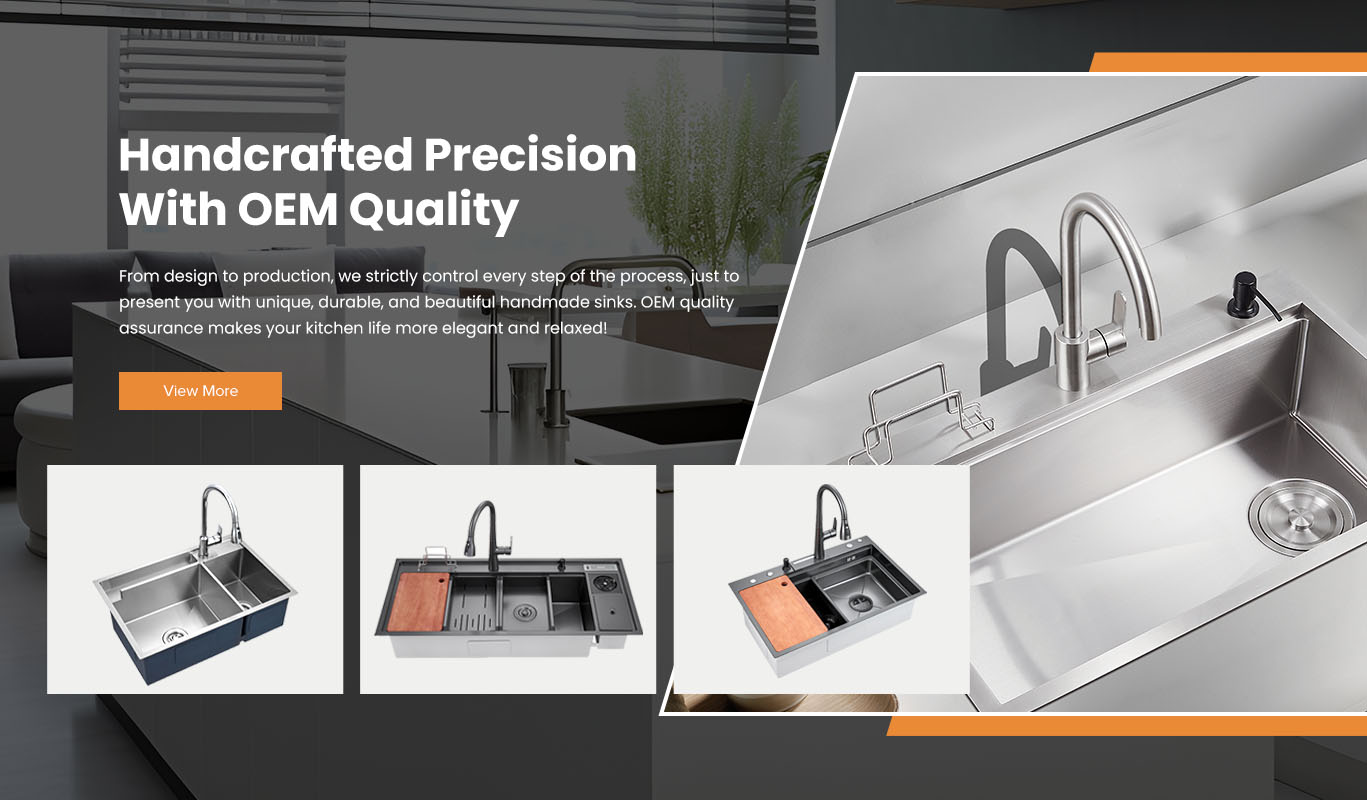
Choosing the right gauge for a stainless steel sink is a critical decision for both residential and commercial applications. The term “gauge” refers to the thickness of the stainless steel sheet used in the sink basin. A proper gauge selection impacts durability, noise performance, cost and longevity. This guide—provided by Shunhan Kitchen & Bath Technology Co., Ltd.—will help you understand what gauge is best for your stainless steel sink, how to compare options, and how our products align with top-quality standards.
In the context of stainless steel sinks, “gauge” is a measure of the sheet metal thickness: the lower the gauge number, the thicker the steel used.
For example:
16 gauge stainless steel ≈ 0.0598 inches (1.52 mm) (per standard chart)
18 gauge stainless steel ≈ 0.0478 inches (1.21 mm)
Thicker material (lower gauge) generally means better resistance to dents, better noise-dampening, and longer structural stability.
Thus, when comparing sinks, gauge is one of the key parameters to evaluate.
Here are four main performance factors that gauge affects, and why they’re important for buyers:
Thicker gauge stainless steel is less likely to bow, dent or flex under heavy use (large pots, constant water flow, etc.). For example, industry commentary notes that 16-gauge offers superior durability versus 18-gauge.
For high-use kitchens (residential with heavy usage, or commercial), selecting a lower gauge is often advisable.
A thicker gauge also tends to reduce noise from running water, clanging dishes or utensils. Because the metal is heavier and less prone to vibration, it dampens sound better.
For installations where quiet operation or a premium feel is important, the gauge plays a role.
Because thicker steel uses more material and manufacturing cost is higher, lower gauge sinks cost more. For instance: 16-gauge > 18-gauge in cost.
However, the higher upfront cost may justify itself by longer lifespan and fewer replacements.
The expected usage environment matters. For residential kitchens with moderate use, 18-gauge may suffice. For commercial or heavy-use environments (restaurants, hotels, busy homes), 16-gauge or even heavier may be preferred.
Thus gauge must be chosen in context of the usage scenario.
Based on industry guidance and typical usage scenarios, here’s a breakdown of what gauge to aim for:
| Usage Scenario | Recommended Gauge | Rationale |
|---|---|---|
| Light residential use, occasional dishwashing, small kitchen | 18-gauge | Lower cost, acceptable performance; thinner metal is acceptable when usage is gentle. |
| Standard residential kitchen, everyday dishwashing, moderate use | 16-gauge | Balanced choice: good durability and performance without extreme cost. |
| Heavy residential use (large pots, frequent cooking) / light commercial use (small cafe, food prep) | 16-gauge or heavier (14-gauge) | For this level of usage, thicker material ensures longevity and stability. |
| Full commercial kitchen (restaurants, institutional use) | 14-gauge or thicker | Commercial grade sinks often use gauges even lower than 16 to withstand intense usage. |
From this table, if you are manufacturing sinks for overseas procurement, specifying 16-gauge premium stainless steel (SUS304 or equivalent) would align with higher performance and longer service life.
At Shunhan Kitchen & Bath Technology Co., Ltd., we design our stainless steel sinks with material and structural integrity in mind. Here’s how our specifications reflect best-practice gauge choices:
We use premium stainless steel grade SUS304 (food-grade) for corrosion resistance and durability.
For our standard high-end models (top mount, undermount, Apron Sinks), we specify 16-gauge material to ensure minimal deformation, excellent noise performance and long service life.
For mid-range or budget models, we may offer 18-gauge variants—suitable for lighter usage environments or lower budget segments—while still maintaining full functionality and aesthetic quality.
We support OEM/ODM customization, so if a client requires an even heavier gauge (e.g., 14-gauge) for commercial kitchen applications, we can accommodate to meet that specification.
Therefore, when presenting our brand to overseas procurement buyers, you can highlight that our sink gauges are specifically selected to match usage scenario, and not simply the minimum standard.
When you (as an overseas buyer) evaluate stainless steel sinks and compare suppliers, here are questions to ask regarding gauge:
What gauge is the stainless steel sheet used in the basin (e.g., 16 or 18)?
What is the actual measured thickness in mm or inches? (Sometimes “16-gauge” is advertised but actual thickness varies)
Is there additional reinforcement (e.g., ribbing, sound-deadening pads, undercoating) that complements a slightly thinner gauge?
What is the expected usage scenario? Will the sink see heavy use, large cookware, or is it for light residential use?
What grade of stainless steel is used (e.g., SUS304 vs lower grade)? Gauge matters but so does alloy quality.
What warranty or durability support is offered (denting, warping, noise performance)?
For custom OEM/ODM models: Can the gauge be adjusted to meet specified performance (e.g., for hospitality projects)?
By asking these, you ensure that the gauge specification aligns with realistic usage and value expectations.
If you are choosing one sink to cover general residential use, aim for 16-gauge stainless steel as the “sweet spot” between cost and performance.
If budget is tight and usage is light (e.g., second sink, bar sink, infrequent use), then 18-gauge can be acceptable—but know the trade-offs (more vibration, higher risk of denting).
For high-end kitchens, commercial installations, or heavy usage, consider even heavier gauge (14-gauge) and ensure proper design reinforcement.
Ensure that the supplier provides full material data (gauge, alloy grade, finish) and performance features (noise deadening, reinforcement) rather than relying solely on gauge number.
Emphasize that gauge is one part of the specification; finish, stainless steel grade, fabrication quality, soundproofing and overall structural design also matter.
Shunhan Kitchen & Bath Technology Co., Ltd. is a specialized manufacturer focused on high-quality stainless steel sinks, offering OEM and ODM services worldwide. Our advantages include:
Use of premium SUS304 stainless steel for excellent corrosion resistance and hygiene.
Precision forming and fabrication—our production processes ensure consistent gauge and uniform thickness across basins.
We provide a range of gauge options tailored to customer needs—from standard residential sinks to more demanding commercial models.
Complete customization: size, finish (brushed, satin, mirror), mounting type (top-mount, undermount, apron/front, bar/rv) and gauge/structure reinforcement.
Full export readiness, and ability to meet overseas procurement specs reliably.
Choosing us means you get a sink with the right gauge for your market—whether you need durability for heavy use or cost-efficiency for lighter use—without compromise.
Gauge is a key specification when selecting a stainless steel sink. While many sinks may advertise “16-gauge” or “18-gauge,” the correct choice depends on your usage, budget and performance expectation. For a strong balance of durability and cost, 16-gauge is often best for general residential use; 18-gauge may suffice for lighter usage. For heavy professional use, thicker gauges (14-gauge) are preferable.
When you select a sink, inspect the material grade, fabrication quality and reinforcement features—not just the gauge number. Our company, Shunhan Kitchen & Bath Technology Co., Ltd., offers tailored solutions with appropriate gauge selection to match your application and market.
Choosing the right gauge ensures that your stainless steel sink will perform well, last longer and provide the quality impression your customers expect.